



The Moon's Familiar Origin Story
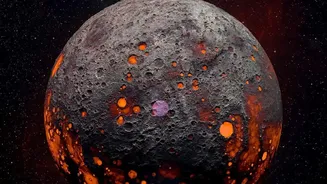
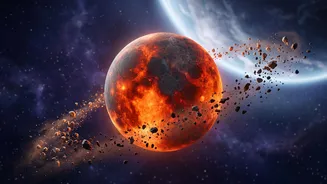
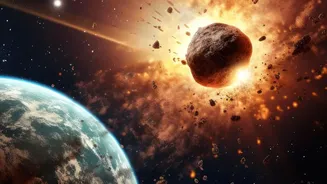
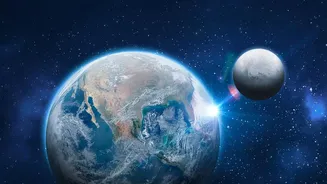
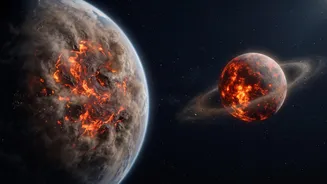
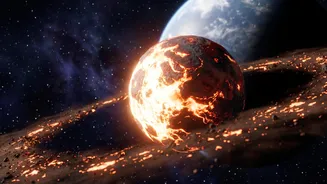
For a long time, the leading explanation for the Moon's existence has been the "giant-impact hypothesis". This theory proposes that about 4.5 billion years ago, a Mars-sized protoplanet, nicknamed Theia, slammed into the still-forming Earth. The cataclysmic
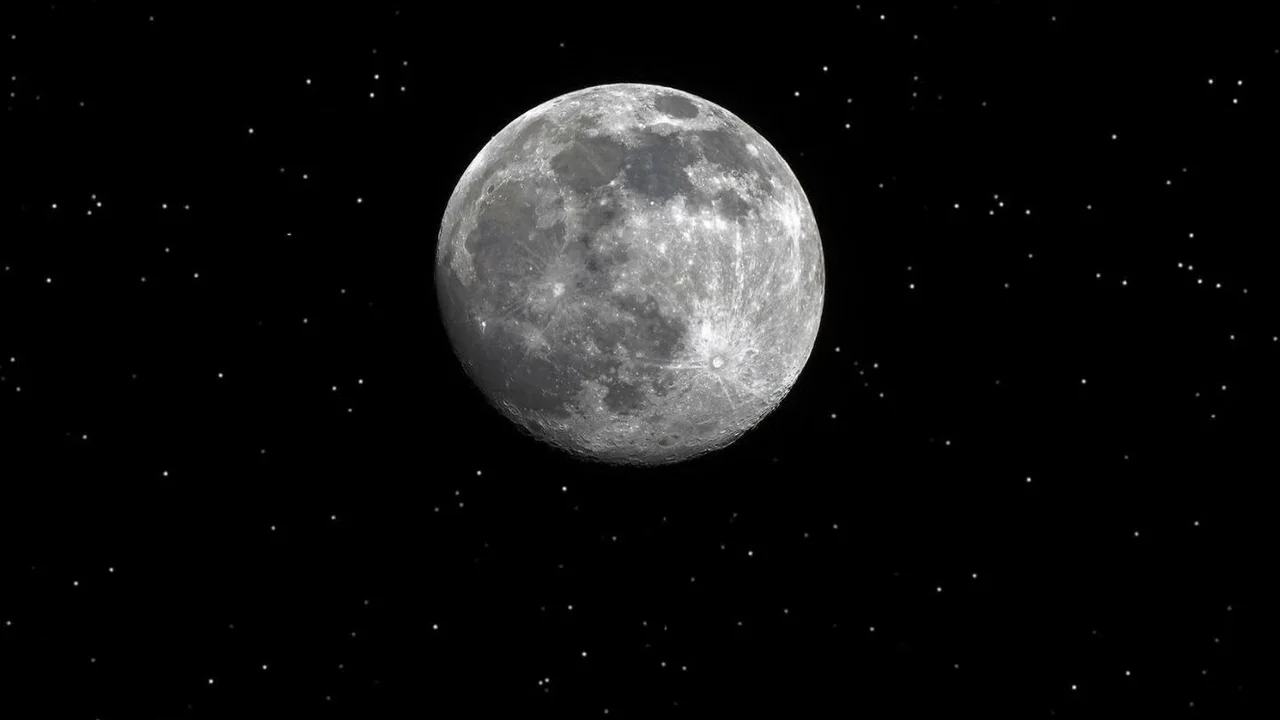
collision would have blasted a massive cloud of molten rock and debris into orbit. Over a long period, potentially thousands or even millions of years, this material would have slowly clumped together, or accreted, eventually forming the Moon we see today. This model elegantly explained several key features, such as the Moon's size, its orbit, and why it has a relatively small iron core. For years, it was the most widely accepted narrative for our satellite's violent birth.
A Major Cosmochemical Problem
Despite its strengths, the giant-impact hypothesis has a significant flaw that has puzzled scientists for decades: the isotopic crisis. Isotopes are versions of elements with different numbers of neutrons. Rocks from different parts of the solar system have unique isotopic signatures, like a planetary fingerprint. The giant-impact model predicts that the Moon should be made mostly of material from the impactor, Theia, with only a smaller contribution from Earth. If Theia came from another part of the solar system, the Moon's isotopic signature should be different from Earth's. However, analysis of the lunar rocks brought back by the Apollo missions showed something startling: the Earth and Moon are isotopically almost identical. It’s as if they are twins, which contradicts a model where the Moon is mostly made from a foreign body.
Rewriting History in a Flash
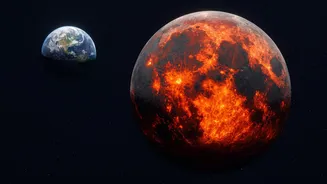
New, high-resolution supercomputer simulations are now offering a dramatic solution to this puzzle. Researchers at institutions like NASA and Durham University have created models that show a different outcome for the Earth-Theia collision. Instead of creating a debris disk that slowly forms the Moon over millennia, these new simulations show that a Moon-like body could be flung directly into a stable orbit within a matter of hours. A recent study led by the Southwest Research Institute further refined this by factoring in the material strength and temperature of the colliding worlds for the first time. Under certain conditions, particularly with a hotter, weaker Theia impacting a young Earth, the collision could produce a large, intact body that becomes the Moon almost instantly. This isn't a slow-motion assembly; it's an immediate birth.
What a Rapid Formation Means
So, what does this new "rapid formation" model mean in practice? Its primary advantage is that it provides a much more elegant explanation for the isotopic similarity between Earth and the Moon. In a scenario where the Moon forms in hours from ejected material, a much larger portion of that material would have come from Earth's own mantle, not just from Theia. The intense energy of the impact would have thoroughly mixed material from both bodies, creating a satellite with a chemical signature almost identical to our planet's. This single-stage formation theory neatly resolves the main objection to the classic giant-impact model without needing to assume that Theia just happened to be an isotopic twin of Earth to begin with. It simplifies the story, aligning the physical model with the geochemical evidence we've had for decades.