


An Enduring Martian Mystery
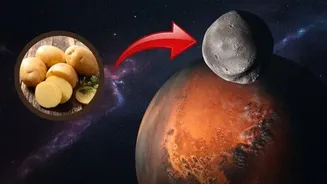
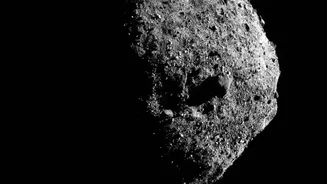
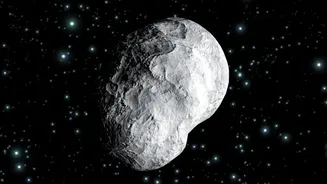
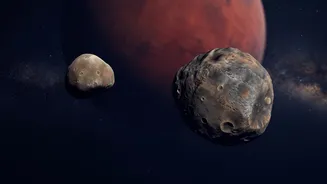
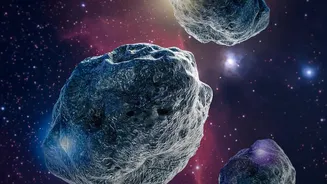
For well over a century, since their discovery in 1877, the moons of Mars have presented a frustrating paradox. Phobos and Deimos are small, lumpy, and dark, sharing many characteristics with the carbon-rich asteroids found in the outer asteroid belt.
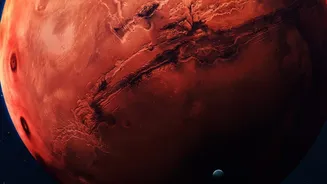
This physical resemblance led to the most obvious and long-standing theory: they were simply passing space rocks that were ensnared by Mars's gravity. However, there is a major flaw in this theory. When a planet captures an object, the resulting orbit is usually eccentric, tilted, and often irregular. Phobos and Deimos, on the other hand, have remarkably orderly orbits. They circle Mars in a nearly perfect circular path, almost directly above the planet's equator. This orbital tidiness strongly suggests they were formed in place, rather than being captured. This fundamental conflict between their appearance and their orbits has fuelled a decades-long scientific debate.
The Two Competing Theories
The scientific community has been largely divided between two main hypotheses: capture versus impact. The 'captured asteroid' theory suggests that Phobos and Deimos are wanderers from the asteroid belt that strayed too close to Mars and were pulled into orbit. This would explain their asteroid-like composition. The primary challenge, however, remains explaining their neat, circular orbits. The alternative, known as the 'giant impact' hypothesis, proposes a far more violent origin. Similar to how Earth's Moon is believed to have formed, this theory posits that a large object, perhaps the size of a dwarf planet, slammed into a young Mars billions of years ago. This colossal collision would have blasted a massive cloud of Martian rock and debris into orbit, which then gradually clumped together to form the two moons. This scenario elegantly explains their circular, equatorial orbits but struggles to explain why the moons don't seem to be made of the same material as Mars.
A New Twist on the Impact Story
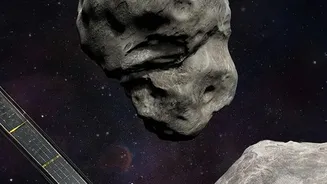
Recent computer simulations are offering a compelling new solution that blends elements of both theories. The latest models suggest the moons could have formed from the debris of a single, large asteroid that was torn apart by Mars's gravity as it passed too close. This 'tidal disruption' event would not have been a direct impact on the planet, but a close shave that shredded the passing body. According to research led by scientists at NASA's Ames Research Center, this process would scatter the asteroid's fragments into a disk around Mars. Over time, the material in this disk would have coalesced to form Phobos and Deimos. This clever model solves two problems at once. First, it explains why the moons have an asteroid-like composition. Second, because they formed from a debris disk orbiting Mars, it accounts for their stable, circular paths. This explanation provides a more complete picture that previous models struggled to achieve.
Why Solving This Puzzle Matters
Determining the true origin of Phobos and Deimos is more than just solving a cosmic curiosity. The answer has profound implications for our understanding of how planetary systems, including our own, form and evolve. If the moons are captured asteroids, it tells us about the orbital dynamics of the early solar system and how materials were transported between planets. If they were born from a giant impact, it sheds light on the violent history of the inner planets and suggests that moon-forming collisions may be a common process. Understanding this history helps piece together the story of Mars itself, including why it evolved so differently from Earth. The formation of its moons is a key piece of the planet's larger historical narrative, offering clues about the conditions that prevailed billions of years ago.
The Mission to Find the Truth
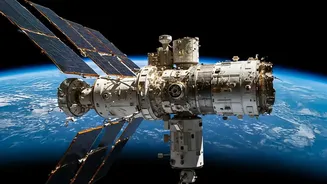
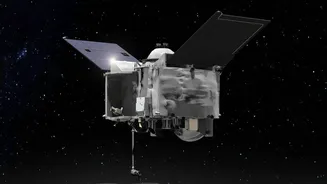
Ultimately, simulations can only take us so far. To find a definitive answer, we need to study the moons up close. This is the primary goal of the Japan Aerospace Exploration Agency's (JAXA) Martian Moons eXploration (MMX) mission, which launched in October 2026. The spacecraft is scheduled to arrive at Mars in 2027, where it will extensively study both moons before attempting to land on Phobos. The most exciting part of the mission is its plan to collect at least 10 grams of regolith—or surface material—and return it to Earth for analysis in 2031. By directly studying a physical sample from Phobos, scientists will be able to determine its composition with unprecedented accuracy. This physical evidence will finally allow researchers to confirm whether Phobos is a piece of Mars blasted into space or an ancient asteroid, settling the debate once and for all.