




A New Eye on the Cosmos
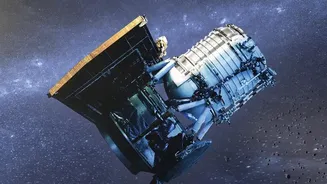
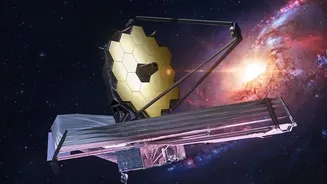
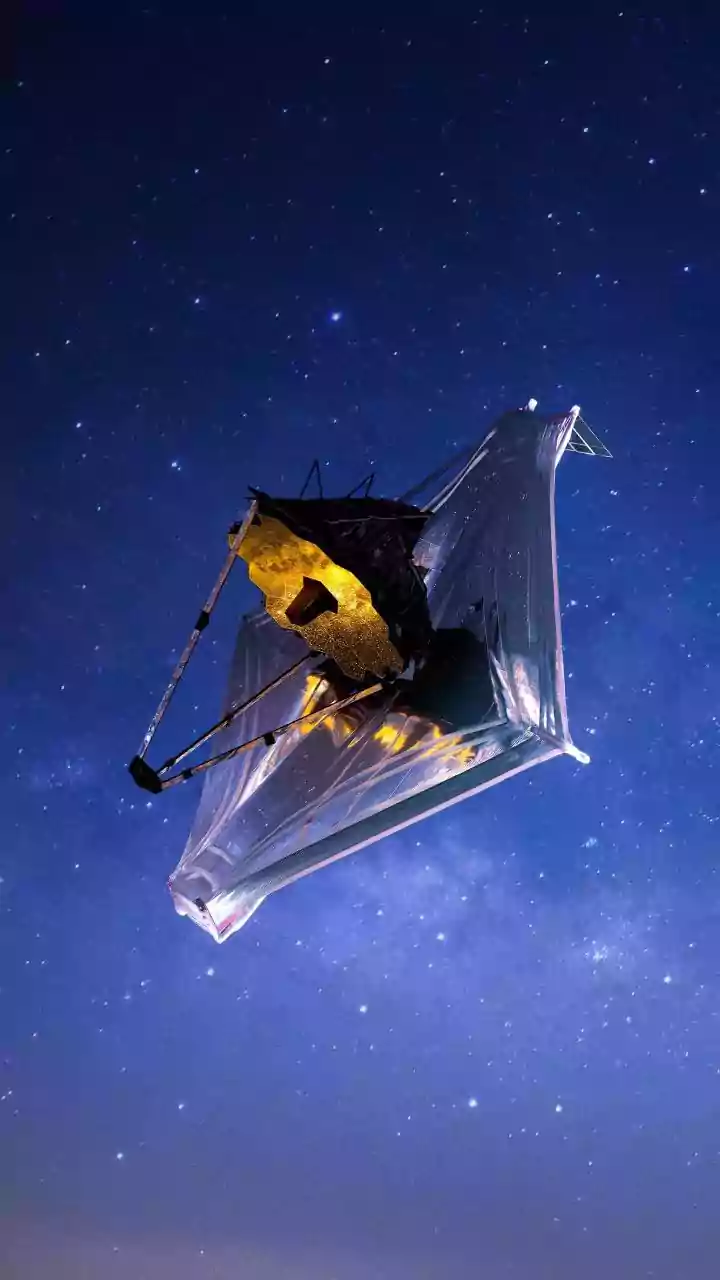
Named after Nancy Grace Roman, NASA's first chief of astronomy and the 'mother of Hubble', the Roman Space Telescope is the agency's next great observatory. Launched aboard a SpaceX Falcon Heavy rocket, it is now on a three-month journey to its operational
orbit about 1.5 million kilometers from Earth. While the iconic Hubble Space Telescope has given us breathtakingly deep, detailed images of small patches of the sky for over three decades, Roman is designed for a different, grander purpose. It’s a survey telescope, built to map vast stretches of the cosmos with incredible speed and efficiency, helping to answer some of the biggest questions in astronomy.
Seeing the Bigger Picture
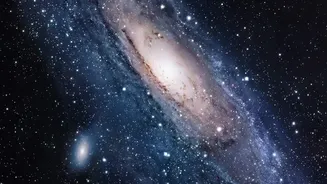
The defining feature of the Roman telescope is its Wide-Field Instrument (WFI). This instrument gives it a field of view that is at least 100 to 200 times larger than Hubble's infrared camera. To put that in perspective, imagine looking at the night sky through a narrow drinking straw—that’s Hubble. Roman is like looking through a panoramic window. Where it took Hubble hundreds of individual pointings to mosaic a large area like the neighboring Andromeda Galaxy, Roman can capture a similar area in just two. It possesses the same mirror size and comparable image sharpness as Hubble but applies it across an enormous canvas. This capability means that during its primary five-year mission, Roman is expected to image an area 50 times larger than Hubble has in its entire 30-plus years of operation.
How Roman Achieves Its Vision
This panoramic capability is made possible by a sophisticated design. The telescope uses a 2.4-meter primary mirror—the same size as Hubble's—that was originally designed for a different purpose and donated by the National Reconnaissance Office. But its optical design is more advanced, allowing for this wider perspective. The Wide-Field Instrument at its heart is a 300.8-megapixel camera, a mosaic of 18 advanced detectors that will capture enormous, high-resolution infrared images. This powerful combination of a large mirror and a massive field of view will allow the telescope to survey the sky a thousand times faster than Hubble.
Unlocking Cosmic Mysteries
Roman's expansive view is not just for creating beautiful cosmic maps; it is a tool for tackling fundamental mysteries of the universe. Its two primary science goals are to study dark energy and dark matter and to discover exoplanets. By surveying the positions and shapes of hundreds of millions of galaxies, Roman will trace how the universe's expansion has changed over time, providing crucial clues about the nature of the dark energy that is speeding it up. It will also hunt for thousands of new exoplanets using a technique called gravitational microlensing, where the gravity of a star and its planets briefly magnifies the light of a more distant star. This method is sensitive enough to find planets with masses even smaller than Earth's.
A Flood of Cosmic Data
Beyond its main objectives, Roman will conduct a massive Galactic Plane Survey, mapping the dense, dusty regions of our own Milky Way galaxy to reveal new details about its structure and how stars are born. This mission will generate an unprecedented amount of information—about 1.4 terabytes of data every day, the highest rate of any NASA astrophysics mission to date. This firehose of data will create a new paradigm for astronomers, enabling statistical studies of the cosmos on a scale never before possible. After a commissioning period, NASA expects to release Roman's first images to the public by early 2027, opening a new window onto the universe.