




The Universe's Phantom Messengers
They are called neutrinos, or 'ghost particles', and for good reason. Lacking an electric charge and having almost no mass, they travel across the universe in a straight line, passing through planets, stars, and entire galaxies as if they were empty space.
This elusiveness makes them incredibly difficult to detect, but it also makes them perfect cosmic messengers. Unlike light, which can be blocked by dust, or charged particles, which are bent by magnetic fields, neutrinos point directly back to their source. To catch them, scientists have built colossal detectors like the IceCube Neutrino Observatory, which uses a cubic kilometre of pristine Antarctic ice. When a high-energy neutrino occasionally collides with an atom in the ice, it creates a faint flash of blue light, a tell-tale sign that allows scientists to reconstruct its energy and direction.
Prime Suspects Under Scrutiny
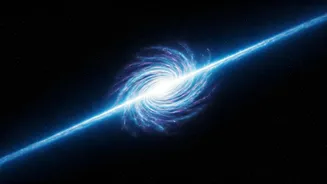
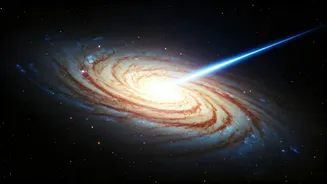
The incredible energy of these cosmic neutrinos—millions of times greater than anything achievable in man-made particle accelerators—means they must be forged in the most extreme environments in the universe. For years, the prime suspects have been blazars, which are the intensely bright cores of distant galaxies. A blazar is powered by a supermassive black hole actively feeding on surrounding gas and dust, and it shoots out a colossal jet of particles and radiation aimed directly at Earth. In 2018, IceCube successfully traced a high-energy neutrino back to a specific flaring blazar, confirming they are at least one source. Other candidates included gamma-ray bursts and the chaotic remnants of exploded stars. For a time, it seemed the mystery was close to being solved, with these obvious, violent events being the primary factories.
A Deep-Sky Discrepancy
However, a puzzle has emerged from the growing catalogue of neutrino detections. While blazars and other active galactic nuclei (AGN) have been linked to some neutrinos, they can't account for the total number that IceCube observes. There simply aren't enough of these known sources in the right places to explain the all-sky glow of high-energy neutrinos. More frustratingly, many high-energy neutrinos have been detected coming from directions in the sky where there are no obvious blazars or other powerful cosmic accelerators. When one particularly energetic neutrino was detected in 2021, astronomers searched its point of origin with every kind of telescope and found nothing—no exploding star, no feeding black hole, just seemingly empty space. This growing discrepancy suggests something else is at play; an entire class of neutrino sources may have been overlooked.
The Hunt for Hidden Accelerators
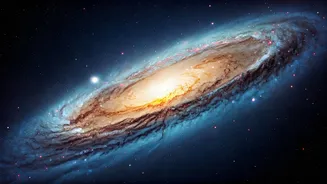
The latest research points towards a new and surprising culprit: starburst galaxies. Specifically, a type of galaxy that is so shrouded in dust that it's nearly invisible to traditional telescopes. Astronomers recently traced the 2021 neutrino to a galaxy 11 billion light-years away nicknamed 'Shadow Blaster'. This galaxy is not powered by an active black hole but by an incredibly intense and compact period of star formation in its core. In this dense, dusty environment, cosmic rays created by massive stars and their explosions collide with the thick surrounding gas, producing a shower of particles that includes high-energy neutrinos. The very dust that hides these galaxies from view is the key ingredient that helps generate the neutrinos. This finding suggests that these hidden star-forming factories, especially common in the early universe, could be responsible for a significant fraction of the ghost particles we detect.