






Our Planet's Fiery Engine
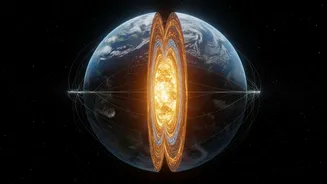
Deep inside Earth lies a core with two parts: a solid inner core of iron and nickel, surrounded by a liquid outer core. This outer core is a superheated, swirling sea of molten metal. The movement of this electrically conductive fluid creates powerful
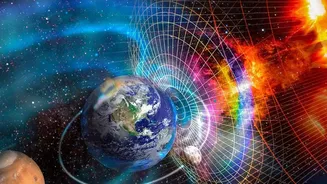
electric currents, turning our planet into a giant electromagnet. This process, known as the geodynamo, generates the magnetic field that extends far into space, shielding us from harmful solar radiation and cosmic rays. For decades, scientists believed the flow of this liquid iron was relatively stable, with a dominant westward drift. But new observations are challenging that long-held assumption.
Seeing the Unseeable from Space
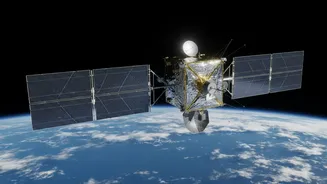
How can we possibly know what’s happening 2,900 kilometres below the surface? We can’t drill down to the core, but we can observe its effects from space. Missions like the European Space Agency's (ESA) Swarm trio of satellites are equipped with highly sensitive magnetometers. These instruments measure Earth's magnetic field with incredible precision. By tracking tiny fluctuations and changes in the field over time, scientists can infer the motion of the liquid iron that generates it. The Swarm satellites fly in a unique constellation, allowing researchers to separate the magnetic signals from the core, crust, oceans, and atmosphere, providing an unprecedentedly clear picture of the core's behaviour.
The Unexpected Reversal
The big surprise came when scientists analyzed data spanning from the late 1990s to the present. They discovered that around 2010, a massive patch of the outer core's flow deep beneath the Pacific Ocean did something unexpected. After years of moving weakly westward, it abruptly reversed course and began flowing strongly to the east. The reason for this sudden and dramatic change remains a mystery. This event suggests that the dynamics of the core are far more turbulent and can change much more rapidly than previously thought, with regional shifts occurring in as little as a decade.
What Does This Reversal Mean?
This is not the beginning of a doomsday scenario. The core-flow reversal does not signal an imminent collapse or reversal of the entire magnetic field, a process which takes thousands of years. Instead, it is a fascinating scientific puzzle. This event, along with other rapid changes known as "geomagnetic jerks," provides valuable clues about the turbulent processes that power the geodynamo. Scientists are now investigating whether this reversal is a temporary fluctuation, part of a longer natural cycle, or the beginning of a new, more stable flow pattern. Recent data even suggests the eastward surge has started to weaken since 2020.
Why This Research Matters
Understanding the core's behaviour is crucial. The magnetic field is not static; it is slowly weakening in some areas, like the South Atlantic Anomaly, and strengthening in others. These changes can affect everything from satellite operations to navigation systems. By studying events like the Pacific flow reversal, scientists can refine their models of the Earth's interior. This research raises intriguing questions about how the inner core, outer core, and mantle are connected and interact with each other. Ultimately, peering into the heart of our planet helps us understand the fundamental forces that make Earth a habitable world.