








The Age-Old Riddle of Water and Stone
Cultures around the world have a saying that captures this paradox: 'Dripping water hollows out stone.' It’s meant to teach persistence, but for scientists, it has been a genuine puzzle. How can something as fluid and yielding as water cause damage to solid
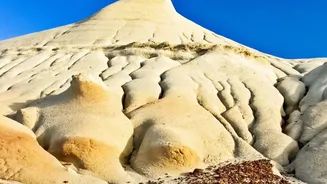
rock, metal, or concrete? For years, researchers have studied this phenomenon, known as rain erosion, but the precise mechanics have been difficult to pin down. We see its effects everywhere, from the slow degradation of ancient monuments and statues to the formation of potholes in our roads and the wearing of wind turbine blades. The cumulative impact is enormous, contributing to billions in infrastructure maintenance and repair costs. Understanding the fundamental process has been the key missing piece.
A Shockwave in a Single Droplet
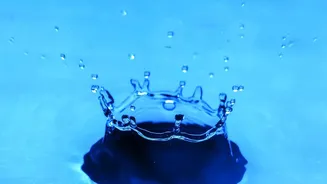
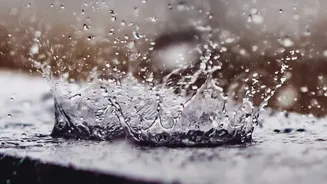
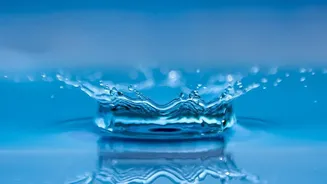
A groundbreaking study has finally provided a clear answer. Using a novel technique called high-speed stress microscopy, researchers were able to measure the hidden forces at play when a water droplet hits a surface. In the past, this was studied visually with high-speed cameras, but this new method quantifies the immense pressure involved. The findings were startling. For a brief moment upon impact, the spreading edge of the droplet exceeds the speed of sound, creating a shock wave. This isn't just a gentle splash; it's a tiny, explosive release of energy. The droplet behaves like a 'small bomb,' generating a spike of pressure, known as water hammer pressure, that is potent enough to fatigue and eventually erode hard materials.
What the New Research Uncovered
The research, led by a team at the University of Minnesota, revealed that the highest stress isn't concentrated at the center of the impact. Instead, the damaging force spreads outward with the rapidly expanding droplet. By directly measuring this shear stress, scientists confirmed that the supersonic splash generates intense pressure waves that propagate into the material itself. These repeated stress events, from billions of individual raindrops over time, cause micro-damage that accumulates, leading to visible erosion. The study helps explain why materials designed to be tough and durable, like protective coatings on buildings or aircraft, eventually fail after prolonged exposure to the elements. It’s a war of attrition waged on a microscopic scale.
Designing for Durability
This new understanding is more than just a scientific curiosity; it has profound practical implications. The insights could pave the way for a new generation of erosion-resistant materials and coatings. Engineers in India and around the world face the constant challenge of building infrastructure that can withstand monsoons and extreme weather. From protecting the integrity of bridges and dams to ensuring the longevity of solar panel installations and preserving ancient, weather-beaten temples, managing erosion is a critical task. By understanding the exact mechanism of failure, companies can design surfaces with textures or properties that dissipate the shockwave from a droplet's impact more effectively. This could lead to longer-lasting roads, more efficient wind turbines with blades that don’t degrade as quickly, and better preservation strategies for our invaluable cultural heritage.