







The Universe's Missing Mass
Our understanding of the cosmos has a huge hole in it, and that hole is filled with dark matter. Scientists are certain it exists because they can see its gravitational effects everywhere they look. It is the invisible 'cosmic glue' that keeps galaxies
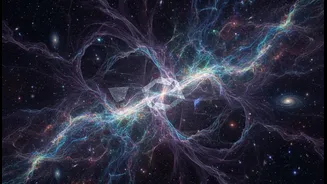
from flying apart and shapes the large-scale structure of the universe. We can map its presence by observing how its immense gravity bends the light from distant galaxies, an effect known as gravitational lensing. Yet, despite making up about 85% of all matter, dark matter has never been directly detected. It doesn't seem to absorb, reflect, or emit any light, rendering it completely invisible to our telescopes and instruments. This profound mystery has left scientists searching for a particle or phenomenon that could explain what this invisible majority is made of.
The Trouble with WIMPs
For a long time, the leading candidate for a dark matter particle was the WIMP, or Weakly Interacting Massive Particle. The theory was compelling, partly due to something called the 'WIMP miracle'. This was a remarkable coincidence: calculations showed that a hypothetical particle interacting via the weak nuclear force would have been produced in the early universe in just the right quantity to account for the amount of dark matter we observe today. This elegant alignment between particle physics theory and cosmological observation made WIMPs a prime target. But there was a problem. Decades of sensitive experiments, including searches at the Large Hadron Collider, have failed to find any evidence for WIMPs, leaving many physicists to conclude that this miracle was a mirage and that a new idea was needed.
An Elegant Fifth Dimension
Enter a fascinating and elegant new proposal from physicists at the University of Sheffield. Their theory suggests that dark matter might reside in a hidden fifth dimension of spacetime. While the idea of extra dimensions has been explored before, this new study adds a crucial twist. The theory posits that the specific geometry of this extra dimension naturally forces dark matter particles and their associated force-carriers, called 'dark photons', to have their masses line up in a very specific arrangement. Previous models often required scientists to artificially 'fine-tune' the numbers to make their theories work, which was seen as a major weakness. This new model suggests the perfect tuning isn't a coincidence but a natural outcome of the dimension's mathematical structure itself.
A Cosmic Resonance
This alignment of masses creates a phenomenon the researchers call 'dark matter resonance'. It can be loosely compared to a musical instrument vibrating intensely when it hits just the right note. According to the theory, this resonance would have made dark matter interact much more strongly at critical moments in the early universe, allowing it to be produced in the correct abundance. At the same time, the model explains why dark matter appears so inert and is so difficult to detect in the universe today. This provides a potential solution to a long-standing puzzle: how dark matter could have been active in the universe's formation while remaining almost completely aloof ever since. The resonance, born from the geometry of a hidden dimension, could be the missing link.
Connecting Two Great Mysteries
What makes this theory particularly exciting is that it connects two of the biggest ideas in fundamental physics: the mystery of dark matter and the potential existence of hidden dimensions. It moves the concept of resonance from a convenient assumption to a natural consequence of a deeper reality. As Dr. Yu-Dai Tsai, one of the study's authors, explained, this gives physicists clear new targets in the search for dark matter. While still a theory, it provides a testable framework. Future discoveries, perhaps from observations of gravitational waves or new particle colliders, could offer evidence to support or challenge the idea. It represents a profound shift in thinking that could reshape our fundamental understanding of the cosmos and what it's truly made of.