




The Universe's 'Failed Stars'
Imagine an object that forms like a star, from a collapsing cloud of gas and dust, but never quite makes it. That’s a brown dwarf. These celestial bodies are more massive than planets like Jupiter but lack the immense gravitational pressure needed to
ignite and sustain the nuclear fusion of hydrogen in their cores, the process that makes stars shine. This is why they are often called 'failed stars'. While they can't burn hydrogen, they are hot from their formation and can briefly fuse a heavier type of hydrogen called deuterium. After that, they spend the rest of their existence slowly cooling and fading, glowing dimly with leftover heat primarily in the infrared spectrum. This places them in a fascinating grey area, an intermediate class of object that challenges our neat definitions of 'star' and 'planet'.
A New Eye on the Cosmos
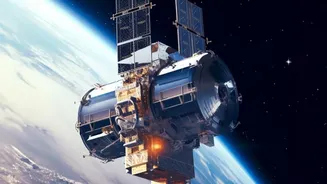
Enter NASA's Spectro-Photometer for the History of the Universe, Epoch of Reionization, and Ices Explorer, or SPHEREx. Launched in March 2025, this space telescope is on a two-year mission to survey the entire sky in near-infrared light, which is invisible to the human eye but perfect for spotting dim, warm objects like brown dwarfs. SPHEREx is creating a cosmic map of unprecedented detail by measuring the brightness of objects in 102 different colours of infrared light. This technique, called spectroscopy, allows scientists to identify the chemical composition of distant objects. As light from a brown dwarf passes through its atmosphere, molecules like water, methane, and carbon dioxide absorb specific colours, leaving a unique chemical fingerprint for SPHEREx to read. This makes it an ideal tool for studying the atmospheres of these dark worlds.
A Surprising Atmospheric Census
The latest findings from the SPHEREx survey, based on an initial analysis of dozens of nearby brown dwarfs, confirm they have incredibly complex and chemically rich atmospheres. The telescope detected the clear signatures of water, carbon monoxide, carbon dioxide, and methane. More importantly, the data revealed that no two brown dwarfs are exactly alike. Even when they have the same temperature, their spectra—their chemical fingerprints—can look remarkably different. These differences hint that a variety of factors are at play, turning these 'failed stars' into a surprisingly diverse population. The findings show that as they cool over billions of years, their atmospheric chemistry undergoes dramatic changes.
Atmospheres in Transition
So, why are they so different? The SPHEREx data suggests that a key reason is the evolution of their atmospheres, particularly their clouds. Hotter, younger brown dwarfs have atmospheres filled with exotic clouds made of molten silicates and metals. As they cool, these clouds can sink or dissipate, a transitional phase that dramatically alters their appearance and chemistry. For example, as a brown dwarf cools, the dominant carbon-bearing molecule can shift from carbon monoxide to methane. The SPHEREx observations show that current atmospheric models struggle to accurately predict what happens during these cloudy transitions, highlighting how varied the process can be from one brown dwarf to the next. This suggests their individual history, mass, and perhaps even their rotation speed contribute to their unique atmospheric makeup.
Clues to Broader Cosmic Questions
Studying the diversity of brown dwarfs isn't just about understanding these specific objects. They serve as a crucial bridge for understanding both star and planet formation. Because they share characteristics with gas giants like Jupiter, studying their weather and atmospheric chemistry provides a natural laboratory for understanding similar processes on exoplanets, which are much harder to observe directly. The thousands of brown dwarfs being catalogued by SPHEREx will give scientists a massive dataset to test and refine their theories on how clouds form and how atmospheres behave under different conditions. According to the research team, this work has turned astronomers into 'accidental meteorologists', charting the weather on these distant, lonely worlds to better understand the cosmos.