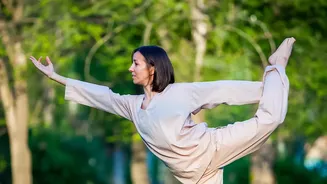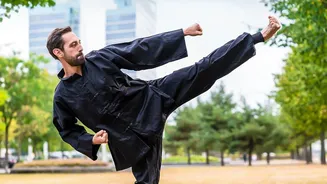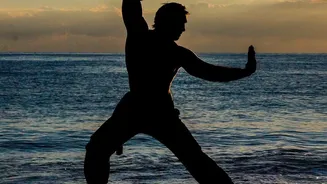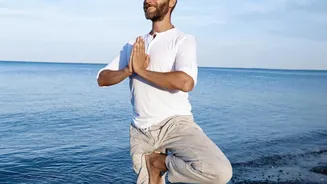






An Unstable Foundation Changes Everything
Performing any exercise on a solid, predictable floor is something our bodies are accustomed to. Sand, however, is an unstable surface. Each time you shift your weight or plant your foot, the ground gives way slightly, forcing your body to constantly
make micro-adjustments to maintain balance. This instability is the key difference. Instead of relying on large muscle groups to power through movements, your body must recruit an army of smaller, stabilising muscles in your feet, ankles, legs, and core. This creates a more intense challenge for your neuromuscular system.
The Search for a Deeper 'Root'
In Tai Chi, a central principle is 'rooting' or 'grounding'. This is the concept of feeling your weight sink deeply into the earth, creating a stable, unshakeable foundation, much like the roots of a tree. On a flat surface, achieving this root is a core skill. On sand, it's a masterclass. The shifting surface makes it incredibly difficult to establish a firm connection. Practitioners find they must focus with far greater intensity, sinking their awareness into the soles of their feet and engaging their core more deeply to avoid toppling over. This challenge doesn't just make the practice harder; it makes the practitioner’s understanding of balance and stability more profound.
Enhancing Proprioception and Mental Focus
This constant battle for balance significantly enhances proprioception—your body's innate ability to sense its position in space. With every movement on the sand, your brain receives a flood of sensory information from your joints and muscles, forcing it to recalibrate your position in real-time. This heightened body awareness is a key reason Tai Chi is recommended for fall prevention. Furthermore, the need to concentrate so intently on staying upright transforms the practice into a powerful form of 'moving meditation'. The rhythmic sounds of waves and the fresh sea air can help synchronize breath with movement, but the core mental workout comes from the unwavering focus required to stay balanced on the unpredictable ground.
So, What About the Calorie Burn?
This brings us to the second part of the headline. While any physical activity burns calories, Tai Chi is not a high-intensity workout. An hour of practice might burn between 200 to 350 calories, depending on a person's weight and the intensity of the style—roughly equivalent to a brisk walk. The added effort of stabilising on sand will increase muscle activation, but it doesn't transform Tai Chi into a cardiovascular powerhouse like running or kickboxing. Research shows that exercising on unstable surfaces can even reduce the maximum force output of muscles, because the body prioritises stability over power. Therefore, the primary benefit isn't a greater calorie burn; it's the significant gains in balance, coordination, core strength, and mindful control.