







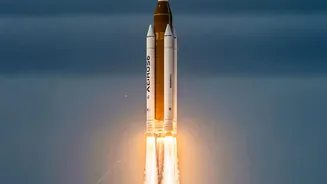
From Historic Launch to a New Frontier
Skyroot Aerospace captured the nation's imagination with the successful launch of its Vikram-1 rocket, becoming the first private Indian company to send a vehicle into orbit. This achievement, accomplished on their first attempt, was more than just a technical
victory; it was a powerful demonstration of the capabilities of India's burgeoning private space sector. Founded by former ISRO scientists Pawan Kumar Chandana and Naga Bharath Daka, the company proved it could design and build a complex, multi-stage orbital rocket, a feat few private entities globally have managed. The successful Mission Aagaman not only placed payloads into orbit but also placed Skyroot at the starting line of a new, even more demanding race. The conversation in their headquarters has now shifted from proving feasibility to mastering execution at an industrial scale.
The Crucial Shift to Serial Production
The term 'flight rate'—how frequently a company can launch—is the ultimate metric of success in the commercial space industry. For Skyroot, the 2026-27 period is dedicated to mastering this. The core mission is to transform their operations from a research and development-focused entity that builds bespoke rockets into a streamlined factory that produces them on an assembly line. Co-founder Naga Bharath Daka has highlighted that after achieving orbit, the bigger challenge begins: repeating the success consistently and reliably at scale. This means moving beyond building a single rocket over several months to a production capacity that can sustain regular commercial flights. It's the difference between being a promising technology demonstrator and a sustainable, revenue-generating business that global satellite operators can depend on.
The Machine That Builds the Machine
Skyroot's immediate goal is to scale its manufacturing to produce one Vikram-1 rocket per month. This is a monumental task that involves more than just speeding up assembly. It requires building robust supply chains for thousands of components, ensuring stringent quality control at every step, and optimizing workflows across its Hyderabad production facilities. The company is leveraging an all-carbon composite structure and 3D-printed engines to aid this process, but scaling up introduces new complexities. According to CEO Pawan Kumar Chandana, the plan involves a short series of test flights to establish commercial readiness before fully committing to a high-frequency launch schedule. This methodical approach is designed to build confidence among customers, whose expensive satellites demand a highly reliable launch service.
India's Space Economy and the Global Race
Skyroot's ambition is perfectly aligned with India's national strategy. The government aims to grow the country's share of the global space economy from about 2% to 8-10% by 2033, with the sector's value projected to increase fivefold to over $40 billion. Private companies like Skyroot are central to this vision. By providing reliable, lower-cost launch services, they can unlock opportunities for satellite operators, data analytics firms, and a host of downstream applications. However, the competition is fierce. Skyroot is not only competing with other Indian startups but also with established international players like SpaceX and Rocket Lab. Achieving a high flight rate is therefore not just a business goal; it is a strategic necessity to capture a meaningful share of the booming global market for small satellite launches.