






What is the Kyber System?
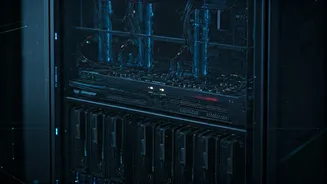
The 'Kyber' system is Nvidia's next-generation rack-scale architecture, designed as the successor to its wildly successful Blackwell and Rubin platforms. It isn't just a single chip but an integrated system of GPUs, CPUs, and advanced networking designed to function
as one cohesive, ultra-powerful machine. Specifically, the Kyber architecture is built to house the 'Rubin Ultra' chips, which were anticipated for 2027. These systems are the foundational building blocks for the massive AI data centres, or 'AI factories', that power everything from large language models to complex scientific simulations. Their design leap involves not just more computing power, but a revolutionary approach to power delivery and cooling, moving to an 800V DC standard to handle the immense energy demands of future AI.
A Major Delay Hits the Roadmap
According to a July 5, 2026, report from semiconductor research firm SemiAnalysis, the flagship Kyber rack system has been delayed by more than a year, pushing its availability into 2028. The primary culprit is reportedly a significant manufacturing challenge with a critical component known as the PCB (printed circuit board) midplane. This complex board is essential for the system's high-speed, all-copper interconnects that allow the dozens of GPUs within the rack to communicate seamlessly. The delay is a significant setback for Nvidia, which had recently committed to an aggressive one-year release cadence for its new AI platforms to maintain its market dominance. Compounding the issue, a related back-to-back rack design, intended to expand scalability, has reportedly been cancelled altogether.
The Data Centre Domino Effect
A delay of this magnitude is far more than a simple product hiccup; it has the potential to cause a domino effect across the tech industry. Hyperscalers like Microsoft, Google, Meta, and Amazon plan their multi-billion dollar data centre construction projects years in advance. These plans are meticulously aligned with the expected arrival, power requirements, and physical footprint of next-generation hardware. A sudden delay to a cornerstone technology like Kyber forces a strategic recalibration. Companies that have already broken ground on facilities designed specifically for Kyber's unique power and cooling architecture may need to pause or pivot. The entire AI infrastructure buildout is a tightly choreographed dance of power grid connections, component lead times, and hardware availability; a delay in one area can cascade, potentially pushing out capacity timelines by months or even years.
An Opening for Competitors?
While a problem for Nvidia and its direct customers, the Kyber delay could create a significant opportunity for competitors. Companies like AMD and Intel have been aggressively developing their own AI accelerators and are also on an annual release schedule. Major cloud providers, who are also Nvidia's biggest customers, have been developing their own in-house AI chips to reduce their dependency on a single supplier. A year-long gap in Nvidia's high-end roadmap could tempt these customers to allocate more of their budget and data centre space to rival platforms from AMD or to accelerate the deployment of their own custom silicon. Analysts suggest this setback could allow competitors to gain ground in the lucrative high-end AI market, a space Nvidia has overwhelmingly dominated.