








A Sudden Shift Deep Underground
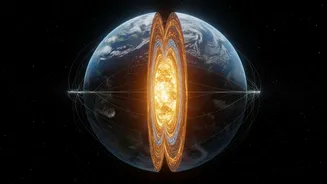
For years, scientists studying Earth's magnetic field believed the flow of liquid iron in the outer core, about 2,200 kilometres below the surface, was relatively stable and moved mostly westward. But in 2010, satellite and ground data revealed something
astonishing: a huge river of molten material deep beneath the Pacific Ocean unexpectedly changed course. What had been a weak westward flow abruptly switched directions, beginning to surge strongly to the east. This reversal was a surprise, challenging the long-held assumption that the core’s large-scale circulation only changed slowly over very long periods. The event showed that the system can vary much more quickly and dramatically than previously thought.
How Do We See the Unseeable?
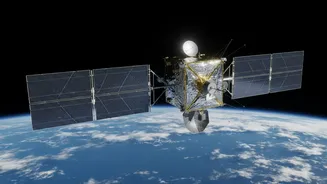
Since we can't physically journey to the Earth's core, scientists rely on indirect methods to study its behaviour. The key is our planet's magnetic field, which is generated by the movement of the electrically conducting liquid iron in the outer core. By using a fleet of highly sensitive satellites, like the European Space Agency's Swarm mission, researchers can measure tiny variations in this magnetic field from space. These subtle fluctuations act as fingerprints, allowing them to reconstruct the flow patterns of the molten iron at the core-mantle boundary. It’s a bit like understanding the currents of a hidden ocean by watching the ripples on its surface. The data from these satellites, combined with ground-based observations, provided the evidence needed to spot the 2010 reversal.
The Bigger Picture: Geomagnetic Jerks
The 2010 event is part of a wider class of phenomena known as “geomagnetic jerks.” These are sudden accelerations in the magnetic field that occur irregularly, roughly every three to twelve years. They aren't felt on the surface but are clear signals in scientific data, appearing as sharp 'V' shapes in graphs of magnetic field changes. For a long time, their cause was a mystery. Scientists now believe these jerks are triggered by disturbances deep within the core, possibly by buoyant blobs of molten metal rising and disrupting the flow. The dramatic flow reversal under the Pacific is now seen as being linked to this turbulent activity, with some researchers noting that a series of geomagnetic jerks were recorded in 2017, possibly related to the earlier changes in 2010.
A Planetary Engine With Moving Parts
The discovery of the Pacific flow reversal adds a crucial piece to the puzzle of our planet's interior. It suggests a dynamic and interconnected system where changes can happen rapidly. Scientists are now exploring whether this reversal was a temporary fluctuation, part of a repeating cycle, or the beginning of a new, stable pattern of flow. Recent data suggests the eastward surge has been weakening since 2020, hinting that it might be an oscillation rather than a permanent change. This event provides new clues about the turbulent processes generating our magnetic field and points to possible connections between the outer core, the solid inner core, and even the rocky mantle above.
Why This Deep-Earth Drama Matters
While a change happening thousands of kilometres underground might seem remote, it's fundamental to our life on Earth. The magnetic field generated by the core acts as a protective shield, deflecting harmful solar radiation and helping to keep our atmosphere in place. Understanding the engine that drives this field is crucial for predicting its future behaviour. Events like geomagnetic jerks and flow reversals complicate our ability to forecast the field's evolution, which is important for the safety and operation of satellites, communication links, and navigation systems. This research isn't about predicting an impending catastrophe but about gaining a deeper, more accurate understanding of the complex and restless planet we call home.