








The Conventional Wisdom on Ice Ages
For decades, the prevailing scientific models suggested that Earth's great glacial periods were driven by long, predictable cycles in the planet's orbit around the sun. These cycles, known as Milankovitch cycles, alter the amount of solar energy reaching
the poles over tens of thousands of years. According to these models, after the last major ice age ended around 11,700 years ago, the planet entered a stable, warm interglacial period—the one we are in now. The next ice age was not expected to naturally begin for many thousands of years, with some estimates putting it as far as 50,000 years in the future, a timeline potentially delayed even further by human-caused CO2 emissions. This framework has been the bedrock of our understanding of long-term climate dynamics.
A Telltale Landscape on Baffin Island
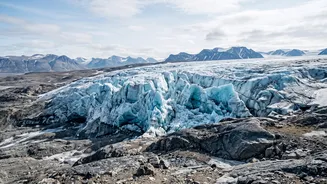
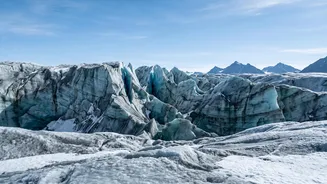
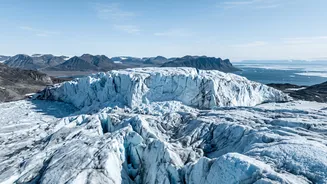
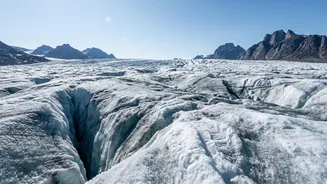
Recent findings, however, are forcing a major reconsideration of this timeline. The key evidence comes from Baffin Island in the Canadian Arctic, a vast, remote landscape that acts as a natural time capsule. Here, the remnants of the ancient Laurentide Ice Sheet, which once covered much of North America, have survived as thin, cold-based ice caps. Unlike massive, grinding glaciers that bulldoze the landscape, these cold-based ice caps are frozen to the ground. As they expand or retreat, they can preserve the delicate vegetation underneath, entombing it for millennia. By studying these newly exposed, perfectly preserved ancient plants, scientists can determine precisely when the ice last advanced over that exact spot.
Recalibrating the Glacial Clock
Using advanced radiocarbon dating on these ancient mosses and lichens, researchers from Columbia University's Lamont-Doherty Earth Observatory made a startling discovery. Their findings suggest that a period of renewed glaciation—effectively the start of a new ice age—had already begun around 2,000 years ago. During a cool period, the ice caps on Baffin Island stopped shrinking and began to expand again. This directly contradicts models that predicted thousands of more years of stable, interglacial warmth. The re-expansion continued for centuries until the 1900s, when rapidly rising summer temperatures linked to industrial-era global warming reversed the process, causing the ice to begin shrinking again. In essence, modern climate change may have halted an ice age that had already quietly begun.
The Power of a New Technique
This research relies on increasingly precise dating methods that give scientists a clearer window into the past. One key technique is cosmogenic nuclide dating. When rock is exposed to the atmosphere, cosmic rays bombard its surface, creating rare isotopes like Beryllium-10. The longer the rock is exposed, the more of this isotope accumulates. By measuring its concentration, scientists can calculate how long a surface has been free of ice. These methods have revealed that some high-elevation surfaces on Baffin Island have survived under non-erosive ice for huge stretches of the last two million years, preserving a complex history of exposure and burial. This intricate record allows scientists to piece together a much more nuanced timeline of glacial activity than was previously possible.
Why This Revision Matters
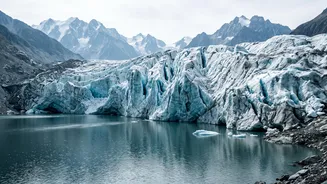
Challenging the timing of ice ages isn't just an academic exercise; it has profound implications for understanding our current climate. It suggests that the Earth's climate system may be more sensitive and can tip into a glacial state more readily than previously believed. The fact that a natural cooling trend was so quickly and decisively overridden by human-induced warming highlights the sheer power of recent anthropogenic climate change. Furthermore, refining our understanding of how and when glaciers grow and shrink is crucial for improving models that predict future sea-level rise. Other recent studies show that current models sometimes underestimate how fast glaciers can retreat, and these new observational findings help create more reliable projections for a warming world.