


Cosmic Potatoes in the Sky
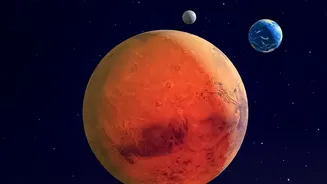
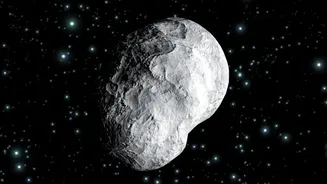
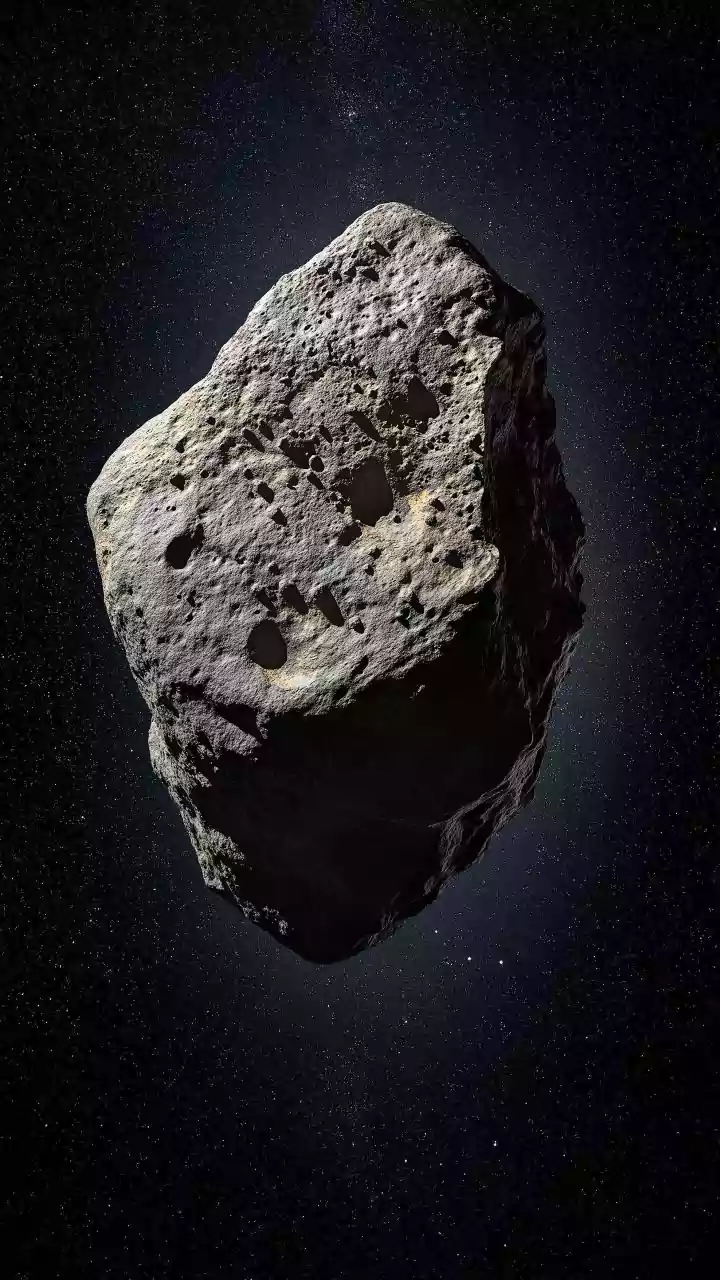
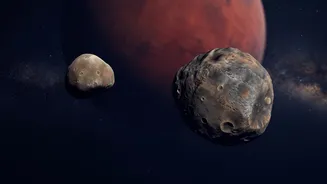
Phobos and Deimos are among the smallest moons in the solar system. Phobos, the larger of the two, is about 27 kilometres across at its widest point, while Deimos is roughly half that size. Both are heavily cratered and dark, reflecting very little light.
Their appearance from the Martian surface would be vastly different from our Moon's. Phobos would appear about half the size of our Moon, but because it orbits so fast—completing a circuit in less than a Martian day—it would rise in the west and set in the east. Deimos, being smaller and farther out, would look more like a very bright star.
Why They Aren't Round
The reason for their irregular, lumpy shapes comes down to a simple matter of physics: gravity and mass. Large celestial bodies like planets and major moons have enough mass that their own gravity is strong enough to pull all their material evenly toward the center. This process, known as achieving hydrostatic equilibrium, crushes the body into a sphere. Phobos and Deimos are simply too small. Their gravitational pull is incredibly weak, insufficient to overcome the structural rigidity of the rock they are made of. As a result, they retain the lumpy, uneven shapes they were formed with, much like asteroids.
The Captured Asteroid Theory
For decades, the leading theory was that Phobos and Deimos are captured asteroids from the main asteroid belt between Mars and Jupiter. This idea is supported by their appearance; their dark, carbon-rich composition is very similar to that of C-type or D-type asteroids. They look like asteroids, and Mars is located right next to the asteroid belt, making the idea seem plausible. However, this theory has a major problem: their orbits. Both moons have remarkably circular orbits that lie almost perfectly along Mars's equator. Captured objects would typically be expected to have much more eccentric, tilted orbits. Getting two asteroids to settle into such stable, circular paths is a difficult scenario to model.
The Giant Impact Hypothesis
A competing theory, which has gained significant traction, is that the moons were born from a violent collision. Much like how Earth's Moon is believed to have formed from debris after a massive impact, Phobos and Deimos may be the remnants of a similar event in Mars's past. According to this hypothesis, a large protoplanet or planetesimal smashed into Mars billions of years ago, blasting a huge amount of rock and debris into orbit. This debris would have formed a ring around the planet, which then coalesced to form the two moons. This scenario neatly explains their circular, equatorial orbits, which would be a natural outcome of forming from a debris disk. Some simulations even suggest a third, larger moon may have formed closer to Mars, which later crashed back down onto the planet.
A Mission for Answers
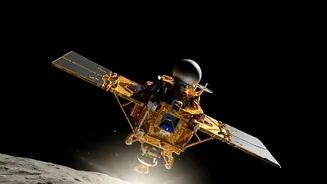
The debate over the origin of Mars's moons remains one of the solar system's great unsolved mysteries. Fortunately, we may not have to wait much longer for an answer. The Japan Aerospace Exploration Agency (JAXA) launched the Martian Moons eXploration (MMX) mission in October 2026. The spacecraft is scheduled to arrive at Mars in 2027, where it will study both moons extensively. The primary goal is to land on Phobos, collect at least 10 grams of surface material, and return it to Earth for analysis by 2031. By studying these samples directly, scientists hope to finally determine their composition and definitively solve the puzzle of whether they are captured asteroids or the children of a great Martian cataclysm.