


The Science of the Lean
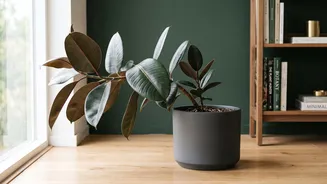
That determined lean towards the light is a natural plant behaviour called phototropism. Plants are hardwired to seek out light because it's their primary source of energy for photosynthesis. This response is driven by a powerful plant hormone called auxin.
Produced mainly in the shoot tips, auxin promotes cell elongation. When a plant gets light from one primary direction, like a window, the auxin moves to the shaded side of the stem. This concentration of auxin on the darker side causes the cells there to grow longer and faster than the cells on the sunny side, making the stem bend and grow towards the light source. It's a clever survival mechanism, but one that results in a lopsided, uneven plant if left unchecked.
Why Rotation Is a Game-Changer
Giving your plant a regular spin is the simplest way to counteract phototropism and ensure it grows into a balanced, robust specimen. When all sides of the plant get their turn in the sun, growth becomes more uniform and symmetrical. This isn't just about looking good; it's about overall plant health. Balanced growth leads to stronger, sturdier stems that can better support the foliage. It prevents the 'leggy' look where one side is dense with leaves and the other is sparse and stretched out. Furthermore, rotation improves air circulation around the entire plant, which can help prevent the buildup of dust and reduce the risk of pests or fungal issues that thrive in stagnant conditions. Each turn also gives you a perfect opportunity to inspect your plant from all angles, letting you catch any potential problems like yellowing leaves or pests early on.
The Art of the Turn
So, how do you do it correctly? The most common and recommended practice is to give your plant a quarter turn at regular intervals. A full 180-degree turn can be a bit of a shock to the plant's system, so a gentle, consistent rotation is better. As for frequency, a good rule of thumb is to rotate your plants every time you water them. This helps create an easy-to-remember routine. For most plants, this might mean a quarter turn every one to two weeks. Plants in lower-light conditions may need more frequent rotations (every few weeks) compared to those in bright, direct light, which might only need turning every month or two. The key is consistency. Pick a direction—clockwise or counter-clockwise—and stick with it. This ensures that over a month or two, every part of the plant will have received equal time facing the primary light source.
Do All Plants Need This?
Most houseplants will benefit from regular rotation, especially fast-growing leafy varieties that are quick to show a lean. However, there are a few exceptions to consider. Some flowering plants, like orchids or Christmas cacti, can be sensitive to changes once they have set their buds. Rotating them at this stage might cause the plant to drop its buds before they bloom. It’s best to let them be until the flowering cycle is over. Similarly, plants that are trained to grow in a specific way, such as vining plants on a trellis or moss pole, have a distinct 'front' and 'back' and generally shouldn't be rotated. For the vast majority of common houseplants, though, from money plants and snake plants to ferns and fiddle-leaf figs, rotation is a simple step that yields fantastic results.