




A World Full of Surprises
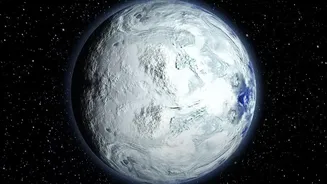
For decades, Pluto was just a faint speck of light. That all changed in 2015 when NASA's New Horizons spacecraft flew by, revealing a world of stunning complexity. Instead of a simple, cratered ice ball, we saw towering mountains of water ice, vast plains
of frozen gases, and a giant, heart-shaped feature named Tombaugh Regio. The western lobe of this heart, a massive glacier of nitrogen ice called Sputnik Planitia, immediately fascinated scientists. It was surprisingly smooth, suggesting its surface was young and being constantly renewed, hinting that Pluto was far from a dead world.
The Tell-Tale Dark Streaks
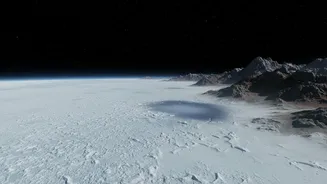
A new analysis of the New Horizons images has provided the most compelling evidence yet of recent liquid flow on Pluto. Researchers focused on the northern part of Sputnik Planitia, where they observed dark linear streaks and diffuse patches along the boundaries of city-sized convection cells of ice. These patterns strongly resemble features seen on glaciers here on Earth, specifically in places like Greenland where meltwater wets and darkens the surface ice and snow. But on Pluto, where the thin atmosphere makes nitrogen rain physically impossible, the liquid couldn't be coming from above. This led scientists to one conclusion: it must be welling up from below.
How to Melt a Frozen World
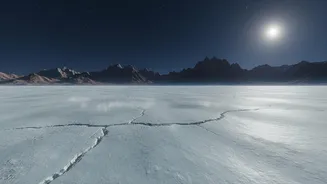
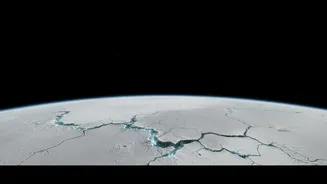
The idea of liquid on a world where surface temperatures hover near -230°C seems impossible, but it comes down to physics. Sputnik Planitia's nitrogen ice is several kilometers deep. Computer models run by researchers, including those at the SETI Institute, show that the immense pressure at the base of this massive glacier, combined with modest heat from Pluto's rocky core, could be enough to melt the nitrogen ice at the very bottom. This creates reservoirs of liquid nitrogen. Because liquid nitrogen is less dense than the solid ice above it, it would be buoyant. This buoyancy, along with pressure from below, could force the liquid up through cracks and fissures in the ice sheet, much like how magma finds its way to the surface in a volcanic eruption on Earth.
A New Kind of Cryovolcanism
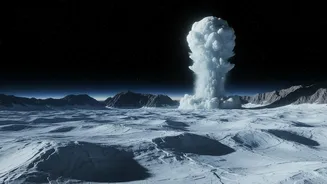
This process is a form of cryovolcanism—volcanoes that erupt volatile substances like water, ammonia, or methane, instead of molten rock. On Pluto, it seems nitrogen is the key player. Once this liquid nitrogen reaches the surface, scientists believe it could remain liquid long enough to flow across the landscape, wetting the ice and creating the dark features observed by New Horizons before it freezes solid again. Alan Stern, the principal investigator for the New Horizons mission, stated that this suggests a new kind of time-variable feature on Pluto, indicating the dwarf planet is geologically active even now, or at least in the very recent past. The surface of Sputnik Planitia is thought to be less than a million years old, which is a blink of an eye in geological terms.
Redefining a Distant World
This discovery fundamentally changes our understanding of Pluto. It's not just a relic from the early solar system; it's a dynamic body with ongoing geological processes that continue to shape its landscape. This subsurface 'plumbing' suggests a more complex interior than previously imagined. The findings also have implications for other distant, icy bodies in the Kuiper Belt, such as Neptune's moon Triton or the dwarf planet Eris. They too might host similar processes, with subsurface liquids occasionally breaking through to the surface. It reinforces the key lesson from the New Horizons mission: the outer solar system is far more active and surprising than we ever knew. The more we look, the more these supposedly simple, frozen worlds reveal deep complexity.