









The New Space Economy Takes Flight
For decades, space exploration was the exclusive domain of government agencies like ISRO. Today, the landscape is transforming at rocket speed. A wave of private companies is now designing, building, and launching everything from satellites to entire
launch vehicles. This shift has unlocked a new era of commercial activity, often called the 'New Space' economy. It's driven by the falling costs of launches and the soaring demand for satellite-based services, from high-speed internet to advanced climate monitoring. The Indian government has actively encouraged this change, opening up the sector in 2020 and establishing bodies like the Indian National Space Promotion and Authorisation Centre (IN-SPACe) to facilitate private participation. This has led to a surge in startups, with India now home to hundreds of private space enterprises, a massive jump from just a handful a few years ago.
Why Space Companies Cluster Together
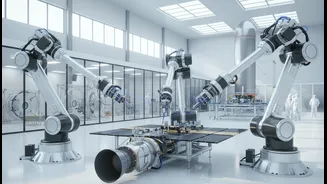
Like Silicon Valley for tech, the space industry thrives on creating specialised regional hubs. These are not just random collections of companies but integrated ecosystems. A launch vehicle manufacturer, for instance, needs a complex supply chain of components, from avionics to advanced composite materials. These hubs naturally form around a gravitational centre, which could be a major research university, a government space facility, or a state with favourable policies. This clustering allows for easier collaboration, a shared pool of skilled talent, and access to capital-intensive infrastructure that a single startup couldn't afford on its own. Recognizing this, the Indian government and various states are actively promoting the creation of these manufacturing clusters. States like Karnataka, Tamil Nadu, and Gujarat are emerging as key players, launching policies and Centres of Excellence to attract investment and build a comprehensive local supply chain.
The Real Jobs of the Space Boom
When you think of space jobs, you might picture astronauts and mission controllers. The reality is far more diverse and grounded. The growth of space manufacturing creates a wide spectrum of employment opportunities. For every rocket scientist, there are teams of technicians, industrial engineers, and quality assurance specialists needed to build and test components. Hyderabad-based Skyroot Aerospace, which is developing its own line of launch vehicles, hires for roles like Methods Engineer, CNC Programmer, and Hardware Quality Engineer. Similarly, Chennai's Agnikul Cosmos, which works out of IIT-Madras, employs professionals in roles ranging from Power Electronics Engineers to Supply Chain Associates. Beyond the technical, these companies also need project managers, IT administrators, finance professionals, and even lawyers specializing in space regulations. The industry's growth is creating a multiplier effect, supporting jobs across logistics, manufacturing, and software development.
India's Emerging Hubs: Bengaluru and Hyderabad
Bengaluru has long been India's aerospace capital, home to ISRO's headquarters and numerous defence and aviation firms. This existing infrastructure has made it a natural hub for space startups. The state of Karnataka aims to capture a significant share of India's national space market, recently launching a state-led Centre of Excellence for Space Technology to foster innovation and talent. Companies like Pixxel, which builds hyperspectral imaging satellites, are part of this growing ecosystem. Meanwhile, Hyderabad has become a centre for launch vehicle development, with companies like Skyroot Aerospace headquartered there. The city's industrial base and engineering talent are a major draw. Even talent from ISRO is moving into the private sector, bringing decades of experience to these new ventures and further strengthening these regional hubs.
Fuelling the Future
The rapid expansion of India’s private space sector is projected to create tens of thousands of high-skilled jobs over the next decade. Projections estimate India's space economy could grow to USD 44 billion by 2033, a significant increase from its current valuation. To sustain this momentum, continued investment, supportive policies, and a focus on developing a skilled workforce are crucial. The government has already signalled strong support, including the creation of a venture capital fund for space startups. As private companies mature from developing prototypes to full-scale manufacturing, the demand for talent across engineering, software, and advanced manufacturing will only intensify. The ecosystem is moving from a government-led research model to a commercially-driven engine for employment and innovation.