



A Celestial Traffic Jam
Imagine a highway with no lanes, no signals, and where cars travel at 28,000 kilometres per hour. Welcome to Low Earth Orbit (LEO). For years, this region of space was vast and empty, but now it’s a bustling hub of activity. According to the European
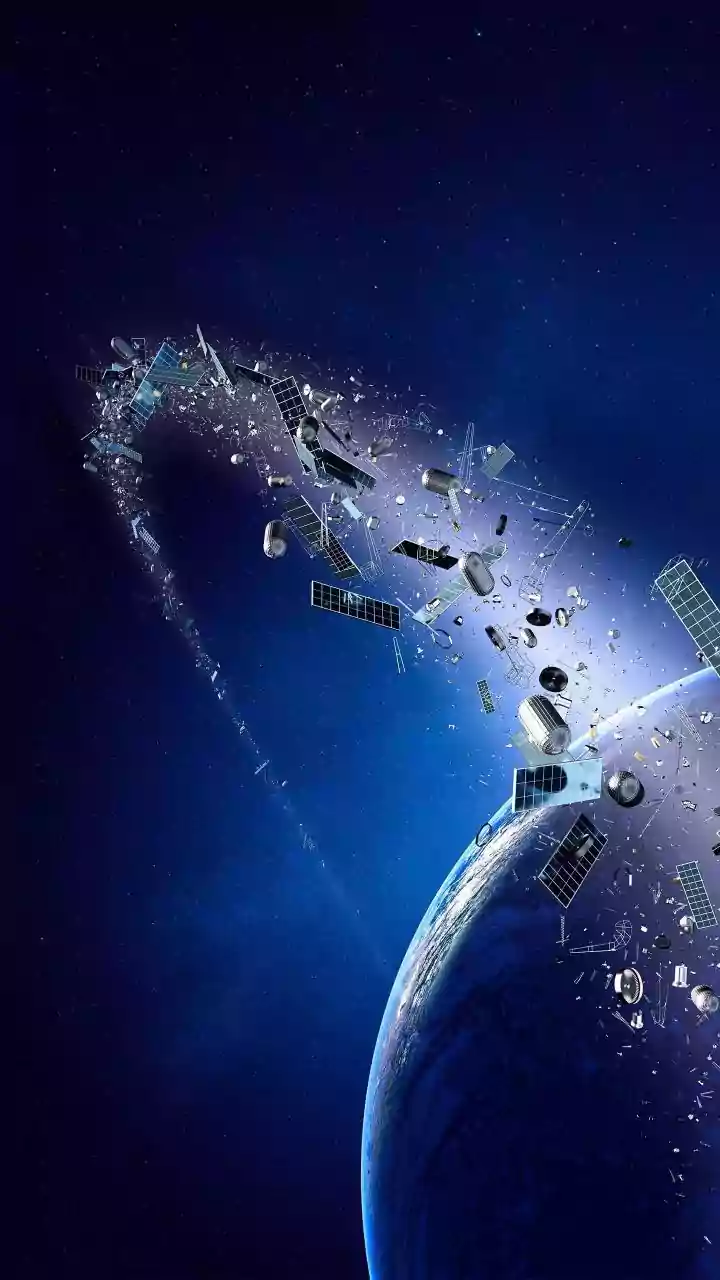
Space Agency (ESA), the number of objects and potential collisions in LEO is now skyrocketing. This has led to a dramatic increase in the need for collision-avoidance manoeuvres. One recent study highlighted that by early 2025, the percentage of satellites needing to perform more than ten such manoeuvres a month had increased sevenfold compared to 2019. While the number of active satellites has grown, they are vastly outnumbered by debris—defunct satellites, spent rocket stages, and fragments from past collisions. These pieces of junk, ranging from the size of a bus to smaller than a centimetre, pose a lethal threat to operational satellites.
The Rise of the Mega-Constellations
The primary driver of this new congestion is the rapid deployment of 'mega-constellations'. These are vast networks of thousands of small satellites launched by private companies like SpaceX's Starlink and Amazon's Project Kuiper to provide global internet coverage. By March 2026, Starlink alone had over 10,000 active satellites, accounting for roughly two-thirds of all active satellites orbiting Earth. The company has plans for tens of thousands more. While these constellations promise to connect remote corners of the globe, they are fundamentally changing the orbital environment. The sheer volume of these satellites, which have relatively short lifespans, dramatically increases the statistical probability of a collision. Reports show that Starlink satellites are already performing hundreds of thousands of avoidance manoeuvres annually, a number that is growing exponentially.
Old Rules in a New Space Race
The rules governing space were not designed for this reality. For decades, the main guideline has been the '25-year rule', a voluntary international principle suggesting that satellites should be removed from orbit within 25 years of their mission's end. This was a reasonable guideline when only a few large, long-lasting satellites were launched each year. However, for a mega-constellation of 40,000 satellites, each with a five-year lifespan, even a 1% failure rate means hundreds of dead, uncontrollable satellites are left drifting in critical orbits every year. Realising this, some bodies like the U.S. Federal Communications Commission (FCC) have moved to a much stricter 5-year deorbit rule for new satellites. But these regulations are not universal, and the overarching international guidelines remain voluntary, with no enforcement mechanism. States legally own their space objects in perpetuity, meaning one country cannot simply remove another's defunct satellite without permission, creating a major roadblock for active debris removal.
The Shadow of Kessler Syndrome
This situation raises the spectre of the 'Kessler Syndrome,' a scenario proposed by NASA scientist Donald Kessler in 1978. He theorised that if the density of objects in LEO becomes too high, a single collision could generate a cloud of debris that triggers a cascade of further collisions, eventually making certain orbits unusable for generations. While we are not at a Hollywood-style doomsday scenario yet, experts warn we are seeing the beginnings of a runaway effect. The ESA noted in a recent report that even if all launches stopped tomorrow, the amount of debris would continue to increase as existing objects collide and break apart. The risk is no longer just theoretical; it's an operational and economic reality for satellite operators who must now constantly manoeuvre to protect their billion-dollar assets.
A Path to Sustainability
Securing the future of space requires a multi-pronged approach. Experts are calling for stronger, legally binding international treaties that harmonise regulations across all space-faring nations. This includes mandating shorter deorbit times, like the 5-year rule, and ensuring all satellites are designed for reliable end-of-life disposal. Beyond prevention, the conversation is shifting toward 'active debris removal' (ADR) – missions designed to capture and deorbit the most dangerous pieces of existing junk. Agencies like ESA are developing technologies for this, but the legal and financial frameworks to support a large-scale clean-up are still in their infancy. Ultimately, the solution will require a combination of technological innovation, robust international policy, and a sense of shared responsibility from the commercial companies now dominating this new frontier.