









A Counterintuitive Climate Finding
Recent modelling studies from Indian research institutes present a fascinating, if complex, picture of the country's environmental future. According to a study published in 'Environmental Research: Climate', India’s forests and vegetation could store
significantly more carbon by the end of the century. The projections are startling: under a high-emissions, fossil-fuel-intensive scenario, the carbon stored in living vegetation could increase by as much as 97% by 2100 compared to historical levels. This finding seems to defy conventional wisdom. As global emissions rise, so too do the negative impacts of climate change. Yet, this research points to a powerful natural feedback loop that could, in theory, work in India's favour.
The Science of CO2 Fertilisation
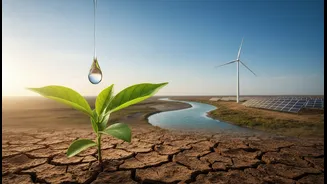
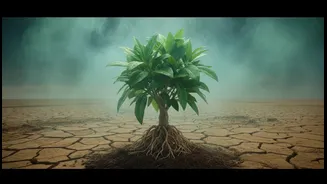
The primary mechanism behind this projected increase is a phenomenon known as the 'CO2 fertilisation effect'. Plants use carbon dioxide for photosynthesis to grow. With more CO2 available in the atmosphere, some plants can grow more vigorously and, as a result, absorb more carbon from the air. A July 2026 study from the Indian Institute of Tropical Meteorology (IITM), Pune, notes that this effect, combined with projected increases in rainfall across many parts of India, is a key driver of increased vegetation productivity. The models suggest that more available CO2 enhances photosynthesis and improves water-use efficiency in plants, allowing them to thrive even in less-than-ideal conditions.
An Uneven Green Boom
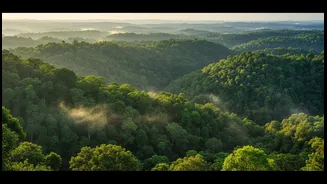
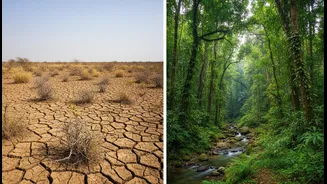
This potential greening, however, would not be uniform across India's diverse landscapes. Interestingly, the largest relative gains in carbon storage are not predicted for India's traditionally lush forest heartlands. Instead, desert and semi-arid zones across Rajasthan, Gujarat, and western Madhya Pradesh are expected to see vegetation carbon rise by more than 60% in a high-emission future. The Trans-Himalayas and the Deccan Peninsula are also projected to see significant gains. In contrast, some of India's most biodiverse regions, like the Western Ghats and the Himalayas, are projected to see smaller increases, possibly constrained by ecological saturation and other climate-related pressures. A separate IITM study does, however, highlight the Western Ghats as a potentially major carbon sink by 2100, showing the complexity and sometimes conflicting nature of these long-term models.
This Is Not a 'Get Out of Jail Free' Card
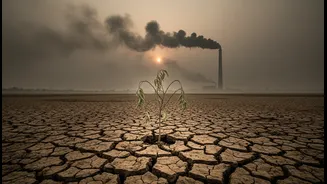
While the prospect of enhanced carbon sinks is welcome, scientists are unanimous in their warnings: this is not a solution to climate change, nor is it a reason to ease up on cutting emissions. The lead author of one study cautioned that these gains might mask deeper stresses on ecosystems. The very same high-emission scenarios that could boost plant growth also bring more frequent and intense heatwaves, droughts, and extreme weather events. These factors can severely weaken and damage forests, potentially negating any benefits from CO2 fertilisation. Higher temperatures are known to suppress plant productivity by increasing heat and moisture stress. Some research even suggests that in recent decades, despite increased greening, the actual carbon uptake in some Indian forests may have already declined due to warming.
The Bigger Picture: Emission Cuts Remain Priority
The potential for increased natural absorption does not change the fundamental equation of climate action. India has set a national goal of creating an additional carbon sink of 2.5 to 3 billion tonnes of CO2 equivalent through forest and tree cover by 2030. While a natural boost could help, relying on it is a risky gamble. Researchers stress that the models do not fully account for real-world risks like wildfires, deforestation, and pest outbreaks, which could release vast amounts of stored carbon back into the atmosphere. The scientific consensus remains clear: the limited uptake potential of natural vegetation means that the top priorities must be the aggressive reduction of greenhouse gas emissions and continued investment in afforestation and ecosystem restoration programs. Natural sinks are a helpful buffer, not a substitute for decarbonisation.