


A Cosmic Conundrum
Imagine looking back in time to the universe’s infancy, less than a billion years after the Big Bang, and finding giants. That's the problem astronomers have faced for years. Observations from telescopes like the James Webb Space Telescope (JWST) have revealed
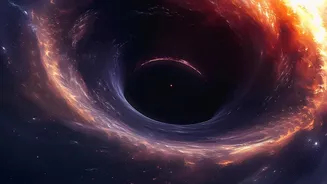
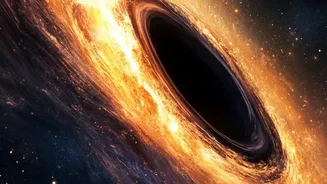
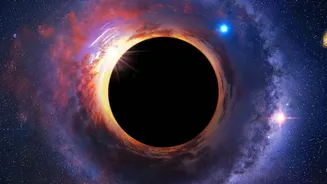
supermassive black holes—objects with millions or even billions of times the mass of our Sun—already lurking in the dawn of time. According to our classic understanding, this shouldn't be possible. Black holes are thought to grow by consuming gas, dust, and stars, or by merging with other black holes. But in the young, less crowded universe, there simply wasn't enough time or material for them to pack on that much weight so quickly. It’s like finding a towering skyscraper built in a single day.
The Search for 'Seeds'
To solve this riddle, scientists have been searching for the 'seeds' of these giants. One leading idea was that the first generation of massive stars collapsed to form black holes, which then grew over time. However, these initial black holes would have been relatively small, perhaps only tens of times the mass of the Sun. Another theory proposed the 'direct collapse' of enormous gas clouds, forming larger initial black holes of around 100,000 solar masses, but the specific conditions required would have been incredibly rare. A third idea even involved primordial black holes formed moments after the Big Bang itself. While all plausible, none of these theories fully explained the sheer scale and frequency of the ancient giants the JWST has been spotting.
An Unexpected Discovery
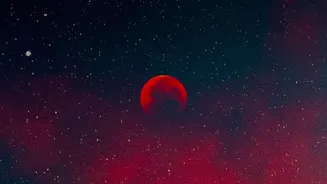
The breakthrough came from an unexpected source: a mysterious, extremely bright red spot in the early universe, spotted in JWST data. Initially catalogued as MoM-BH*-1, this object is unlike anything seen before. It is roughly the size of our solar system but shines with the light of 100 billion suns—an energy output far too immense for any normal star. Its light signature was also strange. While its intense redness suggested it was shrouded in dust, further analysis revealed the colour came from an incredibly dense, pure hydrogen and helium gas cocoon. The object looked like a star, but it was powered like a black hole.
Introducing the 'Black Hole Star'
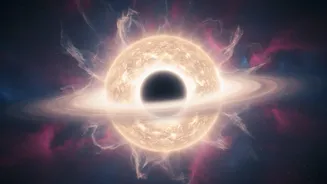
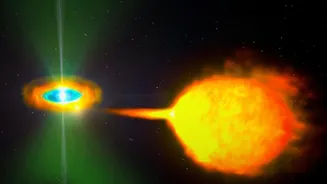
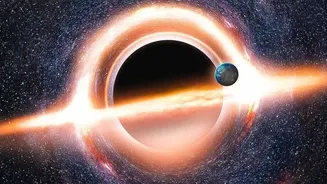
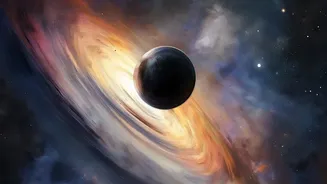
Researchers now believe they have found an entirely new class of object: a 'black hole star', also known as a quasi-star. At its heart is not a fusion-powered core, but a black hole estimated to be around 100,000 times the mass of the Sun. This black hole is surrounded by a massive, star-like envelope of gas. Instead of nuclear fusion providing the object's light, the energy comes from material from the gaseous cocoon falling into the central black hole. This process is so intense it causes the entire structure to glow, appearing to us like a colossal, bright red star. These objects represent a crucial, previously unseen stage in black hole evolution.
The Missing Link Found?
This discovery could be the 'missing link' that explains how supermassive black holes got their head start. Instead of starting small and growing slowly, these 'outsize' black holes could have been born big, inside a 'black hole star'. This object would act as a cosmic incubator, allowing the central black hole to feed and grow rapidly in a protected, gas-rich environment. After several million years, the gas envelope would dissipate, revealing a fully-fledged, massive black hole ready to become the heart of a new galaxy. Scientists suspect that many of the other mysterious 'little red dots' seen in JWST images could also be these black hole stars, suggesting this was a common pathway for black hole formation in the early universe.