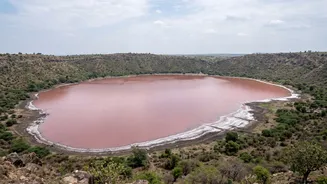









A Crater Lake Like No Other
First, it’s important to understand that Lonar Lake is no ordinary body of water. Located in the Buldhana district of Maharashtra, it is a National Geo-heritage Monument formed by a meteorite impact tens of thousands of years ago. It is one of the few
hyper-velocity impact craters in basaltic rock on Earth, making it a subject of fascination for scientists globally. The lake is unique for being both saline (salty) and alkaline at the same time, with a high pH level. This unusual chemistry creates a specific environment that sets the stage for its dramatic color change.
The Culprit Behind the Pink Hue
The secret behind the pink transformation lies with a group of tiny organisms. Scientific investigations, including a probe by the Pune-based Agharkar Research Institute, concluded that the color is caused by a large population of salt-loving microbes called 'Haloarchaea'. These microorganisms thrive in water with high salinity. Under specific conditions, they produce a pink pigment as part of a protective mechanism. While an alga called Dunaliella was initially suspected, studies confirmed that the biomass of Haloarchaea was the primary reason for the water's pink surface mat.
The Perfect Recipe for a Pink Lake
So, what makes these microbes suddenly create a pink bloom? It’s a combination of factors. The phenomenon is most common during dry, hot weather, typically before the monsoon season. During this period, lower water levels due to evaporation cause the lake's salinity to increase significantly. This high-salt, high-temperature environment, combined with ample sunlight, becomes stressful for the microbes. In response, they produce protective pigments called carotenoids—the same type of compound that gives carrots their color and flamingos their pink plumage. This massive release of pink pigment by the thriving Haloarchaea population is what gives the entire lake its remarkable hue.
Why the Change is Temporary
The headline is correct: this is not a permanent state for Lonar Lake. The very conditions that trigger the pink color also contain the seeds of its reversal. The arrival of the monsoon season is the key factor. As rain pours into the crater, it begins to dilute the water, causing the salinity and alkalinity levels to drop. This change in water chemistry no longer favors the massive population of Haloarchaea. Their biomass subsides, the pink pigment disappears, and the lake’s water begins to return to its typical greenish color as other organisms, like green algae, start to grow again. Laboratory tests have confirmed this; when water samples were left to stand, the pink microbe biomass settled, leaving the water above clear.
A Natural Barometer
This cyclical change makes Lonar Lake a dynamic ecosystem and a fascinating natural barometer. The shift from green to pink and back again is a visible sign of the changing seasons and the delicate balance of its unique aquatic environment. It’s a powerful reminder of how living organisms adapt to extreme conditions and how environmental factors like rainfall and temperature can produce large-scale, visible changes. This recurring phenomenon is not a sign of pollution or something wrong, but rather a healthy, if unusual, sign of life in one of India’s most extraordinary geological wonders.