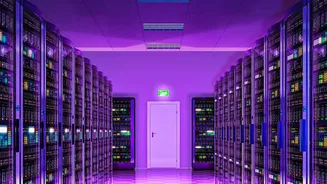








India's digital economy is booming, powered by vast data centres humming with activity. But this growth generates immense heat, posing a critical challenge to efficiency and sustainability. The question is no longer just about capacity, but about cost.
The Heat of a Digital Superpower
India's data centre industry is undergoing explosive growth, with capacity projected to nearly double to 2 GW by the end of 2026. This expansion is fuelled by everything from UPI transactions and cloud adoption to the massive computational needs of Artificial Intelligence (AI). But every server processing data generates heat, and in a facility packed with thousands of them, the thermal load is immense. In a country where many data hubs like Mumbai, Chennai, and Hyderabad already face extreme heat and water stress, cooling isn't a luxury—it's a fundamental operational challenge. Traditional air-cooling systems, which can account for 30-40% of a data centre's total energy consumption, are being pushed to their limits, leading to soaring electricity bills and straining local power grids.
Beyond Just Air Conditioning
For years, the standard approach has been to use Computer Room Air Conditioner (CRAC) or Air Handler (CRAH) units, which function like supercharged ACs, often in a 'hot aisle/cold aisle' layout to manage airflow. The efficiency of this model is measured by a metric called Power Usage Effectiveness (PUE), a ratio of the total energy used by a facility to the energy delivered to the IT equipment. An ideal PUE is 1.0, but the industry average hovers around 1.5, meaning for every watt used for computing, another half-watt is spent on overheads like cooling. In India's hot and humid climate, achieving a low PUE with air cooling alone is incredibly difficult and expensive. As rack densities increase with powerful AI-focused chips, which generate far more heat, conventional air cooling is simply becoming ineffective.
A Deep Dive into Liquid Cooling
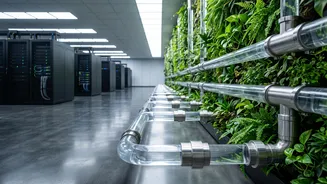
This is where advanced liquid cooling comes in. Instead of cooling the entire room, these systems target the heat at its source. There are two primary methods gaining traction. The first is Direct-to-Chip (DTC) cooling, where liquid is circulated through cold plates placed directly on top of hot components like processors and GPUs. The second, more radical approach is immersion cooling, where entire servers are submerged in a specialised, non-conductive dielectric fluid. Because liquids transfer heat far more effectively than air, both methods can drastically reduce the energy needed for cooling. This shift is becoming less of a choice and more of a necessity, especially for new AI data centres where the heat generated by a single rack can be too much for air-based systems to handle.
The Efficiency and Sustainability Equation
The primary benefit of adopting liquid cooling is a significant improvement in efficiency. By drastically cutting down on the energy required for cooling, data centres can lower their PUE, in some cases approaching an ultra-efficient 1.1. This translates directly into lower operational costs and a reduced carbon footprint. Furthermore, because liquid cooling is so effective, it allows operators to pack servers more densely, getting more computing power out of the same physical footprint. For a country facing water scarcity issues in key data centre hubs, closed-loop liquid cooling systems also offer a major advantage over traditional evaporative cooling towers, which consume enormous amounts of water. This improved efficiency extends hardware lifespan by maintaining stable operating temperatures and reducing thermal stress on components.
The High Cost of Staying Cool
Despite the clear advantages, the transition to liquid cooling is not without hurdles. The main barrier is the significant upfront capital expenditure. Implementing these systems, especially retrofitting them into existing facilities, requires substantial investment in new infrastructure like coolant distribution units (CDUs), specialised piping, and servers designed for immersion. A detailed analysis shows that while a new-build liquid-cooled facility can have a capital cost per watt roughly equal to a traditional air-cooled one, the initial outlay for specialised equipment is high. There is also a need for a skilled workforce trained to design, operate, and maintain these complex systems, which presents another challenge for widespread adoption.