





Meet Beta Pictoris d
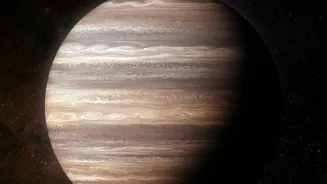
The newly found world, named Beta Pictoris d, is a gas giant estimated to be at least twice the mass of Jupiter. It joins two other known planets, Beta Pictoris b and c, in orbit around their young, bright star. This discovery makes the Beta Pictoris system
only the second ever found to have at least three directly imaged planets. Located about 23 million years old, this nearby system serves as a crucial natural laboratory for scientists studying how planets form and evolve in their early stages. The star was already a subject of intense focus; Beta Pictoris b was one of the very first exoplanets to ever be directly photographed. Now, the unexpected discovery of a third companion adds a fascinating new layer to an already complex family portrait.
A Planet Hiding in Plain Sight
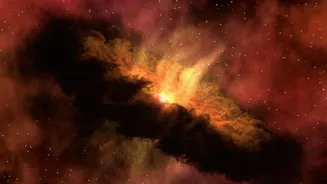
So if astronomers have been studying this system for so long, how did a planet this massive stay hidden? The answer lies in the challenging environment around the star. Beta Pictoris is surrounded by a bright, thick disk of cosmic dust and debris left over from its formation. This dust scatters the star's light, creating a glare effect much like driving through a thick fog. This intense glare made it nearly impossible for previous telescopes to distinguish the faint light of a planet from the bright, chaotic structures within the dusty disk. Standard imaging techniques simply couldn't cut through the noise to spot the planet as a distinct point of light.
Webb’s Revolutionary Technique
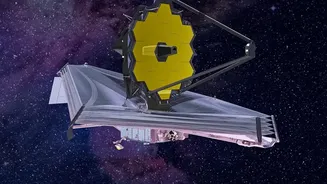
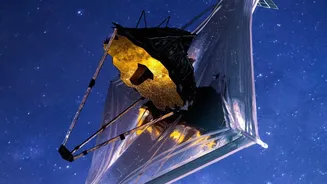
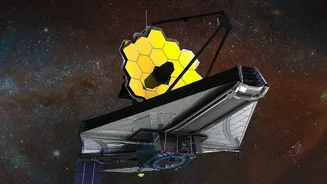
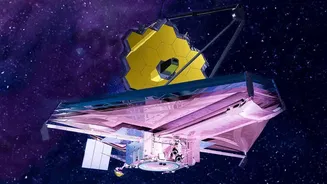
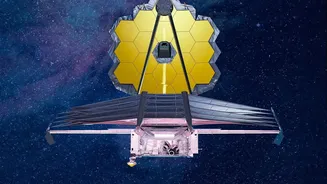
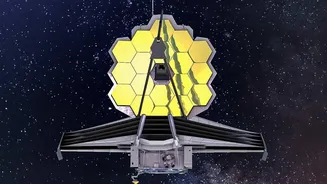
This is where the technological power of the James Webb Space Telescope proved decisive. Instead of trying to find the planet's faint glow, astronomers used a completely different and more powerful method. Using Webb's Near-Infrared Spectrograph (NIRSpec), they were not looking for a planet at all but were analysing the system's chemical composition. The instrument detected the unique chemical fingerprint of an atmosphere—specifically, traces of carbon monoxide. This tell-tale chemical signature was a dead giveaway that something large and planetary was lurking in the data, even if it couldn't be seen directly. Follow-up observations with another Webb instrument, MIRI, confirmed the presence of methane and water vapour, cementing the object's status as a planet. This method of finding a world by its atmospheric 'scent' rather than its light could transform the search for other elusive exoplanets.
Rewriting the Story of Planet Formation
The discovery of Beta Pictoris d isn't just a technical achievement; it has profound implications for our understanding of the cosmos. The planet has the widest orbit of the three known worlds in the system, a fact that challenges existing models of how such massive planets form and settle into their paths. Its existence may also help explain some of the unusual features of the star's debris disk, including its sharp inner edge. Every new planet adds a vital piece to the puzzle of planetary evolution. This particular discovery was accidental; the team was originally studying Beta Pictoris b when the chemical signal for the new planet unexpectedly appeared in their data. It highlights how much we still have to learn, even about our closest cosmic neighbours.