


Our Galaxy’s Miniature Monster
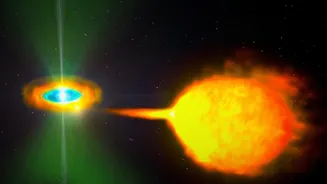
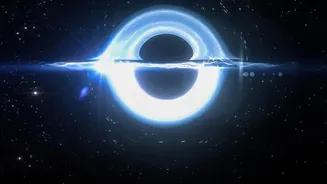
Imagine a black hole, but not the supermassive kind that sits at the centre of galaxies. Instead, picture a smaller one, just about ten times the mass of our sun. Now, pair it with a massive, hot star in a cosmic dance. This is the scene at the heart
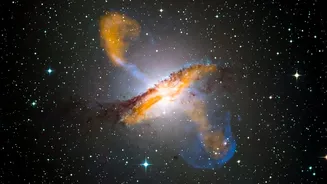
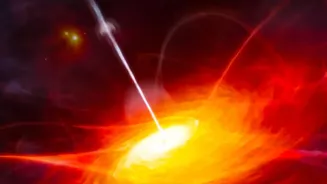
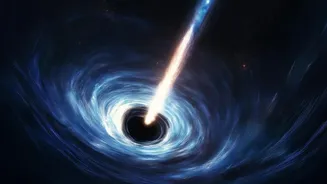
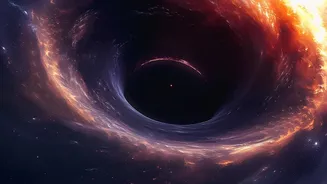
of a microblazar. The black hole’s immense gravity pulls material from its companion star. As this gas spirals inward, it forms a scorching-hot disc that, through complex physics, launches two powerful, oppositely directed jets of particles and radiation travelling at a significant fraction of the speed of light. The key difference between a microblazar and its larger cousin, the blazar, is scale. Blazars are powered by supermassive black holes billions of times our sun's mass in distant galaxies. Microblazars are their stellar-mass counterparts, predicted to exist right here in the Milky Way, but they have remained elusive until now.
Spotlight on IRAS 18293-0941
The candidate object, IRAS 18293-0941, was first catalogued decades ago but was largely forgotten, hidden behind a thick veil of interstellar dust that made it invisible to optical telescopes. Recent analysis using a battery of instruments observing across the electromagnetic spectrum—from radio waves to gamma rays—pieced together a new picture. An international team of scientists found a binary system where a black hole and a massive companion star orbit each other every 11 days. Crucially, they detected a relativistic jet, a stream of matter moving at about 75% of the speed of light, pointed almost directly at Earth. This specific orientation is what defines a microblazar and makes the object appear unusually bright to us, a phenomenon known as Doppler boosting.
A Cosmic Laboratory in Our Backyard
The discovery is significant because it provides a much closer look at processes that were previously only observable in blazars billions of light-years away. Having a microblazar within our own galaxy gives scientists an unparalleled opportunity to study how black holes launch these incredibly powerful jets. Because events happen on much faster timescales in these smaller systems, researchers can watch cosmic evolution play out in months or years, rather than centuries. While the jet pointed towards Earth makes the object detectable, it's the jet firing in the opposite direction that adds another layer of intrigue. Astronomers believe this receding jet is slamming into a dense molecular cloud about 100 light-years away from the black hole.
A Galactic Particle Accelerator
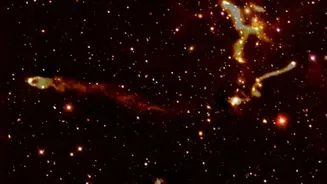
This collision between the jet and the gas cloud is thought to create a massive particle accelerator. The impact creates a 'hotspot' that could accelerate particles to peta-electronvolt (PeV) energies, which is about 100 times more powerful than what can be achieved at the Large Hadron Collider on Earth. This finding might solve another long-standing mystery: the origin of some of the most energetic cosmic rays detected in our galaxy. Scientists have noted that IRAS 18293-0941 is located near a known source of ultra-high-energy particles, suggesting the connection is more than a coincidence. It offers a compelling model for where these powerful cosmic rays come from, establishing microblazars as potentially some of the most powerful natural accelerators in the Milky Way.