





An Icon Born From Necessity
The story of the Targa begins in the mid-1960s, with a uniquely American problem. Rumours swirled that the United States, a critical market for Porsche, was preparing to ban conventional convertible cars over safety concerns. For a company that thrived
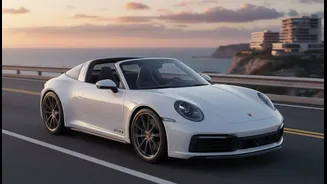
on selling open-top sports cars, this was a potential disaster. Instead of abandoning the segment, Porsche’s engineers created something entirely new: the world's first 'safety cabriolet'. Introduced in 1965, the 911 Targa featured a fixed, wide roll bar made of brushed stainless steel, a removable roof panel, and a wrap-around rear window. This design provided the open-air experience drivers craved while offering the structural integrity of a coupe and rollover protection. Named after the famed Targa Florio road race in Sicily, a brutal event Porsche had dominated, the name itself was a statement of performance and resilience. It wasn't just a solution; it was an instant design icon.
The Middle Years: A Lost Identity?
For nearly three decades, the Targa maintained its classic formula: removable top and signature roll bar. However, with the introduction of the 993 generation in 1995, Porsche took a radical turn. The iconic Targa bar vanished, replaced by a sophisticated, electrically operated sliding glass roof that slid under the rear window. This design, which continued through the 996 and 997 generations, was technically clever, offering a large glass canopy that created a bright, airy cabin even when closed. But for purists, something essential was lost. While these cars were Targas in name, they had shed the key visual element that defined their identity. The distinctive silhouette was gone, replaced by a profile that was nearly indistinguishable from the standard coupe, leading many to feel the model had lost its way.
A Mechanical Ballet Returns the Soul
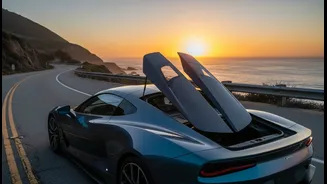
With the 991 generation in 2014, and continuing with the current 992, Porsche engineered a stunning return to form. The designers understood that to bring back the Targa's soul, they had to bring back the bar. But how could they do that without resorting to a cumbersome, manually removed roof panel from the 1960s? The answer is a piece of breathtaking mechanical theatre. At the push of a button, the entire rear glass section lifts up and hinges backward, seemingly floating over the rear of the car. Two small flaps in the Targa bar open, allowing the fabric roof section to unfurl, fold into a Z-shape, and tuck itself away into a compartment behind the seats. The glass then gracefully returns to its position. The entire process takes just 19 seconds. It’s a complex, dramatic, and brilliantly engineered solution created for one purpose: to restore the original, iconic Targa profile.
More Than Just a Pretty Roof
While the roof is the headline act, its success is enabled by the thoroughly modern car beneath it. The latest Targa is built on the 992 platform, which means it benefits from decades of engineering refinement. All Targa models now come standard with all-wheel drive, providing immense traction and stability that makes the car's performance accessible in various conditions. Advanced systems like Porsche Active Suspension Management (PASM) electronically adjust the dampers for a ride that is both comfortable for cruising and taut for spirited driving. The interior is a blend of classic design cues, like the analog tachometer, and modern technology, such as high-resolution touchscreens. This modern foundation provides the performance, safety, and comfort expected of a new Porsche, creating a perfect stage for the nostalgic Targa experience to shine.
Preserving the Feeling, Not Just the Look
The triumph of the new Targa is not just that it looks like its ancestors, but that it feels like a modern interpretation of the original idea. The driving experience is a unique compromise between a coupe and a full convertible. With the top off, you get the wind-in-your-hair sensation, but the wide Targa bar provides a sense of security and reduces wind noise compared to a traditional soft-top. With the roof closed, the car is as quiet and refined as a coupe. Some critics point out that the complex roof mechanism adds weight compared to its Carrera siblings, but for Targa buyers, that's beside the point. They are choosing a car for its style, its versatility, and its direct connection to a rich heritage. The modern engineering isn't a gimmick; it’s the very thing that makes the car’s original identity possible in the 21st century.