




An Object That Didn't Behave
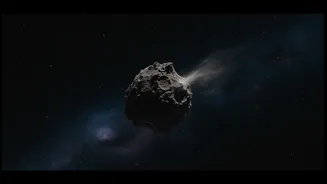
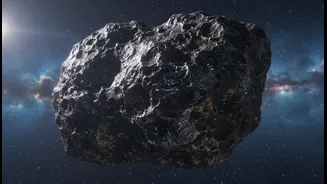
The story begins with an object known as 1998 SH2. Discovered in 1998, it was classified as a near-Earth asteroid—a chunk of rock orbiting our Sun. For years, it seemed unremarkable, showing none of the classic signs of a comet, like a glowing coma or a visible
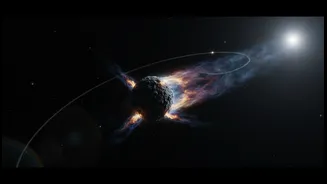
tail. But when astronomers prepared for its close approach in August 2025, they hit a snag: 1998 SH2 wasn't where all the calculations said it should be. This discrepancy suggested that gravity wasn't the only force acting on it. Something else was giving it a tiny, unexpected push, a phenomenon known as nongravitational perturbation. This was the first clue that 1998 SH2 had a secret.
The Ghost of a Tail
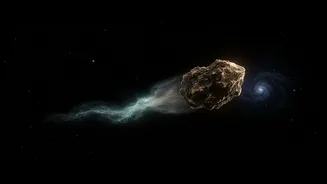
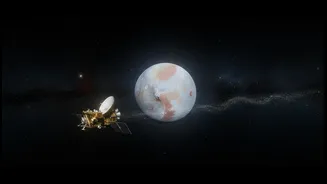
The strange motion led scientists, including a team at NASA's Jet Propulsion Laboratory, to hypothesize that 1998 SH2 might be a comet in disguise, venting small amounts of gas that were too faint to see but strong enough to alter its path. To test this, they used some of the world's most powerful telescopes during the 2025 flyby, including the Canada-France-Hawaii Telescope and the European Southern Observatory's Very Large Telescope. The new, deeper images confirmed their suspicions. They revealed a weak but clear tail and a faint coma of gas and dust. The asteroid was officially reclassified as a comet, now also known as P/1998 SH2.
Meet the 'Dark Comets'
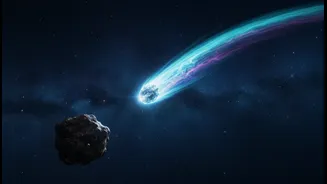
The discovery of 1998 SH2's true identity shines a light on a mysterious class of celestial bodies known as 'dark comets'. These are objects that have comet-like orbits and show nongravitational movement, but lack the spectacular visible activity of their more famous cousins. Some are also called 'Manx comets', a nickname borrowed from the tailless cat breed. They are thought to be ancient comets that have either exhausted most of their surface ice or have developed a crusty, inactive surface that seals the remaining volatiles inside. This leaves them looking like asteroids, but behaving like comets, making them incredibly difficult to identify.
A Hidden Population
The confirmation of 1998 SH2 is significant because it suggests there could be a large, undiscovered population of these stealthy comets in our cosmic neighborhood. Researchers estimate there are thousands of known near-Earth asteroids with orbits similar to Jupiter-family comets. How many of them are actually dark comets masquerading as inert rocks? This was the first time an object's cometary nature was predicted from its orbital deviations before being visually confirmed, providing a new method for hunting these objects. Identifying them is crucial not only for understanding the solar system but also for planetary defense, as the unpredictable outgassing makes their paths harder to forecast than those of stable asteroids.
Clues to Our Origins
Beyond planetary safety, these dark comets may hold keys to our own origins. Some scientists believe these objects could have been responsible for delivering water and organic materials—the building blocks of life—to an early Earth. Many of these comets, sometimes called 'Lazarus comets', are thought to have formed in the inner solar system before being flung into a deep freeze at the solar system's edge, preserving their ancient composition. Studying them is like looking at a pristine sample of the material that formed our planet billions of years ago. The discovery of 1998 SH2's faint tail opens up a new chapter in the census of our solar system, reminding us that even in our own backyard, there are still plenty of secrets hiding in the dark.