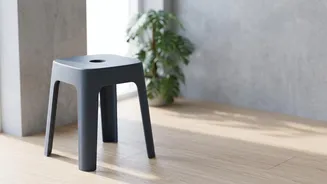








Not Just for Carrying
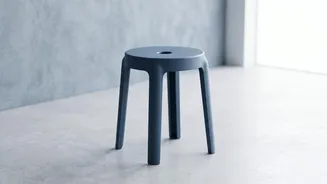
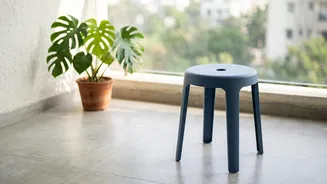
The most common assumption about the hole is that it's a finger grip to make the stool easier to pick up and move around. While it certainly serves that function, calling it just a handle is selling this clever design short. This simple opening is the key
to solving several surprisingly complex problems that arise when you try to make, use, and store thousands of these ubiquitous seats. The convenience of carrying it with one finger is more of a happy bonus than its primary reason for being. The true genius of the hole lies in physics and manufacturing efficiency, solving problems you probably never knew existed.
Defeating the Vacuum
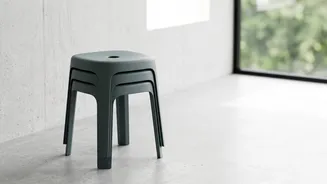
The primary and most critical reason for the hole is to prevent a vacuum from forming when stacking the stools. Imagine stacking two stools without holes. The top stool would create an airtight seal with the one below it. As you push them together, the air trapped between the seats gets compressed. When you try to pull them apart, you're fighting against atmospheric pressure. The space between the seats becomes a low-pressure zone, and the higher air pressure outside pushes down, effectively locking them together. This phenomenon, known as suction or vacuum lock, can make it incredibly difficult to unstack them. The hole allows air to escape as the stools are stacked and to enter as they are unstacked, equalizing the pressure and ensuring they never get stuck. This is crucial for businesses and event venues that need to store and deploy hundreds of stools quickly.
Strength and Durability
It might seem counterintuitive that removing material would make an object stronger, but in this case, the hole plays a role in the stool's durability. When you sit on a stool, your weight is distributed across the surface. A solid, flat surface can be prone to cracking under stress, especially at the center where pressure can be concentrated. The hole, being circular, helps distribute stress evenly across the seat and prevents it from concentrating in one area. If the hole were square, the sharp corners would become points of weakness where cracks could easily start. The round shape avoids this, helping to prevent the center from bowing or fracturing over time. This ensures the stool remains robust and safe for use over a longer period, even with frequent and heavy use.
Efficiency in Manufacturing
The benefits of the hole begin long before the stool is ever stacked or sat on; they start at the factory. Most plastic stools are made using a process called injection molding. The hole can make it easier to remove the finished stool from the mold without causing damage. Furthermore, a large, solid piece of plastic is more prone to warping and other defects as it cools. The hole breaks up this large surface, allowing for more even cooling and reducing the likelihood of imperfections. While the material saved on a single stool is minimal, when producing millions of units, this small reduction adds up, making the manufacturing process faster, more reliable, and more cost-effective.