








What is a K-Shaped Economy?
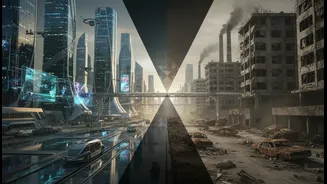
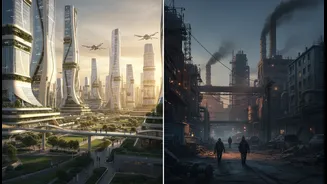
Imagine the letter ‘K’. After a period of economic disruption, one arm of the letter points upward, while the other points down. This is the visual metaphor for a K-shaped economy. It describes a recovery or economic shift where different parts of the economy move
in opposite directions. Some sectors, companies, and individuals see their fortunes rise sharply (the upper arm), while others experience stagnation or decline (the lower arm). This concept gained prominence during the COVID-19 pandemic, which accelerated wealth for some while devastating others, but Moody's now argues AI is the new, powerful force driving this divergence globally.
AI as the Great Divider
According to Moody's, the booming demand for AI has acted as a cushion, preventing a sharper global slowdown. However, this has created a two-speed economy. On one hand, massive investment in AI infrastructure like data centres, a surge in exports from Asia's tech-focused economies, and soaring stock valuations for AI-related companies have propped up global activity. On the other hand, industries and economies not deeply connected to the AI boom have struggled, hit by unrelated challenges like geopolitical tensions and trade disruptions which have increased business costs. The result is a widening gap between those who are equipped to ride the AI wave and those who are not.
The Winners: Riding the Upper Arm
The clearest winners are the technology and communication services sectors. These are the companies building the AI models, manufacturing the advanced chips, and developing the software that underpins the revolution. Beyond the creators, professional, scientific, and technical service sectors are also leading adopters, using AI to boost productivity and offer new services. Countries with strong tech industries and the ability to invest heavily in AI infrastructure are also poised to benefit disproportionately, particularly advanced economies. For individuals, those with skills in data science, AI development, and creative problem-solving are seeing their value and compensation rise. Moody's notes that investment in this cycle has become a key source of resilience for the global economy.
The Losers: On the Downward Slope
The downward arm of the 'K' represents sectors with limited exposure to AI or those whose core functions are vulnerable to automation. Traditional industries like agriculture and construction have shown low adoption rates so far. While AI is unlikely to pour concrete, it could disrupt many of the planning and administrative roles within these fields. More broadly, any industry or role based on routine manual or cognitive tasks is at risk. This divergence isn't just between sectors, but also between countries. Emerging markets and economies with less capacity to invest in AI and upskill their workforce may fall further behind, potentially exacerbating global income inequality. Moody's warns that this group is struggling while the AI-powered sectors race ahead.
What This Means for India
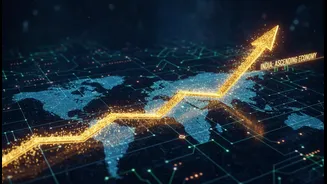
For India, this K-shaped trend presents both a massive opportunity and a significant challenge. The country's world-class IT services sector is well-positioned to be on the upper arm of the 'K', developing and implementing AI solutions for global clients. This could drive exports and create high-value jobs. However, India also has a vast workforce in sectors that could be disrupted. The key will be managing this transition. It requires a dual focus: continuing to foster innovation and leadership in the tech sector, while simultaneously investing heavily in reskilling and upskilling programs to help workers in vulnerable sectors adapt. The government's policy choices, along with the strategic direction of Indian businesses, will be critical in determining whether AI lifts the entire economy or deepens existing inequalities.