






A World More Active Than We Imagined
For decades, Pluto was a distant, blurry speck, assumed to be a geologically inert world. That all changed in 2015 when NASA's New Horizons spacecraft flew by, revealing a stunningly complex and active surface. Now, a fresh look at that data provides
the most compelling evidence yet that Pluto isn't just active, but may have recently had liquid flowing on its surface. A study led by the Southwest Research Institute (SwRI) points to features in Pluto's famous heart-shaped region that suggest liquid nitrogen has been seeping up from below. "Pluto never stops surprising us," said Alan Stern, principal investigator of the New Horizons mission and the study's lead author. This finding overturns the old view of Pluto as a static, frozen world, replacing it with a picture of a dynamic body with ongoing geological processes.
The Clues in Pluto's Heart
The focus of the research is a massive glacier of frozen nitrogen called Sputnik Planitia, which makes up the western lobe of Pluto's 'heart'. It’s a vast basin, larger than the states of Texas and Oklahoma combined, covered in city-sized polygonal cells of nitrogen ice. Between these cells, New Horizons imaged dark, narrow lines and broader, diffuse patches. Scientists have long been intrigued by these markings. The new analysis suggests these features were created when the frozen surface was temporarily 'wetted' by liquid nitrogen. To support this idea, researchers compared the images from Pluto with satellite photos of the Greenland ice sheet on Earth. On our own planet, similar dark patterns appear where liquid water from below the ice seeps up and wets the snow and ice on top. The resemblance is striking and suggests a similar process, with a very different liquid, is at play on Pluto.
How Cryovolcanism Works on Pluto
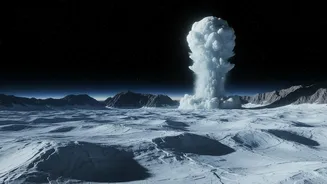
So how can liquid exist on a world where surface temperatures hover around minus 235 degrees Celsius? It can’t come from rain, as Pluto’s thin atmosphere makes that impossible. Instead, scientists propose a form of cryovolcanism, or ice-volcanism. Computer models developed by the SETI Institute show that deep beneath Sputnik Planitia's kilometres-thick ice sheet, the pressure combined with modest heat from Pluto’s rocky core could be enough to melt the nitrogen ice at its base. Being less dense than the solid ice above it, this liquid nitrogen would be buoyant. It would then be forced upwards through cracks and fractures in the glacier, in a process similar to how magma rises through Earth's crust. When it reaches the surface, it briefly flows and wets the ice, creating the dark features, before refreezing in the extreme cold. This wouldn't be a steady flow, but likely periodic bursts from underground reservoirs.
What This Means for Icy Worlds
This discovery isn't just about Pluto; it has major implications for our understanding of other frigid bodies in the outer solar system. The process of subsurface melting and eruption could also be happening elsewhere. For instance, it might help explain the mysterious geysers of nitrogen gas that the Voyager 2 spacecraft observed on Neptune’s largest moon, Triton, back in 1989. Other distant dwarf planets like Eris, which also appear to have thick nitrogen ice deposits, could host similar activity. This research reinforces a key lesson from the New Horizons mission: small, icy worlds can remain geologically active for billions of years, powered by mechanisms we are only just beginning to understand. It shows that you don't need the roaring heat of a rocky planet like Earth to have complex and fascinating geology. The cosmos, it seems, is full of surprises, even in its coldest corners.