



A Surprising Discovery
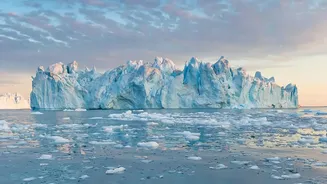
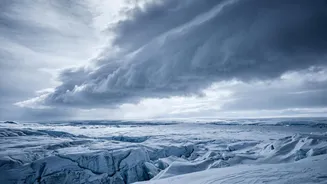
A recent study has made headlines by revealing that the Antarctic Ice Sheet gained a remarkable 695 billion tons of mass between 2021 and 2023. This finding, captured by satellites, represents the largest short-term ice gain ever recorded by the GRACE
satellite missions and seems to contradict the dominant narrative of melting poles. The study, published in the journal Nature, traced the cause to a seemingly unrelated event: sustained warming in the tropical western Pacific and eastern Indian Ocean. This distant warming altered atmospheric patterns, creating a pathway that funnelled enormous amounts of moisture towards East Antarctica, resulting in exceptionally heavy snowfall.
A Tale of Two Ices
To grasp the study's implications, it is crucial to understand the difference between land ice and sea ice. Land ice, which makes up the colossal Antarctic Ice Sheet, is formed from compacted snow that falls on the continent. When this ice melts and flows into the ocean, it adds new water, directly causing sea levels to rise. Sea ice, on the other hand, is simply frozen ocean water. Like an ice cube in a glass, its melting does not significantly raise the overall water level because it was already part of the ocean's volume. The recent study is about an increase in land ice mass due to snowfall, which is a different phenomenon from the expansion or contraction of the sea ice that fringes the continent.
An Anomaly, Not a Reversal
While a 695-billion-ton gain sounds enormous, scientists are clear that this event does not reverse the continent's long-term trend of ice loss. Over the last two decades, Antarctica has been losing ice at an average rate of about 140 to 150 billion tons per year. This new gain, though significant, is viewed as a temporary blip driven by a specific, short-term atmospheric connection to the tropics. In fact, the most vulnerable areas, particularly the West Antarctic Ice Sheet, have continued to lose mass even during this period of heavy snowfall in the East. The glaciers in West Antarctica, such as the Thwaites and Pine Island glaciers, remain a primary concern for scientists due to their rapid melt driven by warming ocean waters.
The Bigger Picture: A Warming World
Paradoxically, the mechanism behind this ice gain is linked to a warming world. Warmer air can hold more moisture, leading to more intense precipitation events, including snowfall in polar regions. The study shows how warming in one part of the globe (the tropics) can have dramatic and unexpected consequences thousands of miles away. This complex interplay highlights that climate change doesn't always manifest in straightforward ways. It can create regional or temporary counter-trends that are part of a much larger, and more concerning, global pattern of disruption. The overall health of the Antarctic Ice Sheet is still firmly on a downward trajectory.
Why It Matters for India
The fate of Antarctica's ice is not a distant, abstract problem. The total amount of ice locked on the continent is enough to raise global sea levels by nearly 58 meters if it all melted. Even a small increase in the rate of melt has profound implications for coastal communities worldwide. For India, with its 7,500-kilometer coastline and major population centres like Mumbai, Chennai, and Kolkata located in low-lying areas, the threat of sea-level rise is acute. Understanding every nuance of Antarctic ice dynamics, including temporary gains and accelerating losses, is critical for accurately projecting future sea-level rise and preparing for its impacts.