



The Ghost Particle
The story begins with a neutrino, one of the most elusive particles in the cosmos. Neutrinos are fundamental particles with almost no mass and no electric charge, allowing them to pass through planets, stars, and entire galaxies as if they were empty
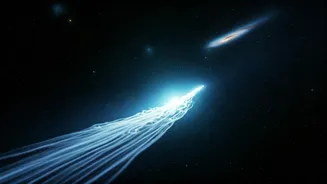
space. This is why they're often called 'ghost particles.' Trillions pass through your body every second, completely unnoticed. However, a tiny fraction of these are 'high-energy' neutrinos, carrying immense power from violent cosmic events. Detecting them is a monumental task, requiring massive observatories like the IceCube Neutrino Observatory buried deep in the Antarctic ice. On September 22, 2021, IceCube detected one such powerful neutrino, dubbed IC 210922A, and the hunt for its source began.
A Cosmic Crime Scene
When IceCube detects a high-energy neutrino, it sends an alert to astronomers worldwide. Telescopes across the globe then pivot to the patch of sky the particle came from, searching for a flash of light, gamma rays, or any other signal of a catastrophic event that could have created it. Initially, the search for the source of IC 210922A came up empty; there was no obvious exploding star or flaring black hole. However, a team using the James Clerk Maxwell Telescope in Hawai'i found a faint source of submillimeter radio waves in the right direction. This clue pointed not to a typical suspect, but to something much more mysterious: an extremely bright galaxy shrouded in so much dust it was nearly invisible to optical telescopes.
Enter the 'Shadow Blaster'
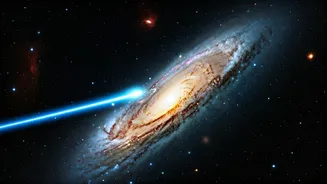
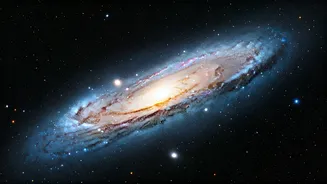
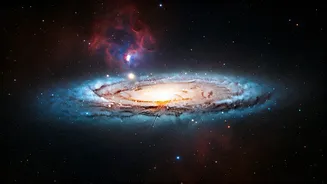
Follow-up observations with the powerful Atacama Large Millimeter/submillimeter Array (ALMA) revealed the source was a galaxy named JCMT0402-0424, located 11 billion light-years away. Because it was so obscured by dust, making it look like a shadow, scientists nicknamed it the 'Shadow Blaster.' Further investigation revealed something incredible: the galaxy's light was being bent and magnified by a massive elliptical galaxy in the foreground, a phenomenon known as gravitational lensing. This cosmic magnifying glass allowed astronomers to study the Shadow Blaster's internal structure in detail they otherwise couldn't achieve. What they found was surprising. Instead of a supermassive black hole powering the galaxy's immense brightness, they saw signs of frenzied, violent star formation—a 'starburst' galaxy.
A New Kind of Engine
Until now, the prime suspects for creating high-energy neutrinos were blazars—galaxies with supermassive black holes that shoot jets of particles directly at Earth. But the Shadow Blaster showed no evidence of such a jet. Instead, scientists believe this galaxy’s dense, compact, and turbulent core acts as a natural particle accelerator. In this chaotic environment, energetic particles produced by countless supernova explosions from massive, short-lived stars are trapped by tangled magnetic fields. They repeatedly collide with the dense gas clouds, and these collisions are powerful enough to forge high-energy neutrinos, which then escape and travel across the universe.
The Bigger Picture
This discovery is a major step forward in 'multi-messenger astronomy,' where scientists combine information from different cosmic messengers—like light, gravitational waves, and neutrinos—to get a complete picture of an event. Finding a neutrino from a starburst galaxy suggests there may be a whole new class of sources for these high-energy particles. Previously known sources like blazars couldn't account for the total number of high-energy neutrinos detected by IceCube. Scientists estimate that dusty, compact starburst galaxies like the Shadow Blaster, which were common during an era known as 'Cosmic Noon,' could be responsible for as much as 20% of the universe's entire high-energy neutrino background.