

What Did Astronomers Find?
An international team of astronomers has identified an object, named MoM-BH-1, that existed just 660 million years after the Big Bang. At first glance, it looks like a star, but it shines with the energy of 100 billion suns—far too bright for any single
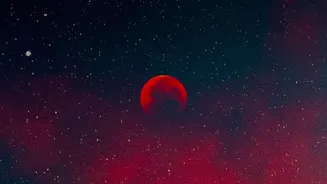
star to physically produce. This mysterious object is roughly the size of our solar system and is distinguished by its extremely red color and a unique light signature that has baffled scientists. Unlike other objects that appear red because of cosmic dust, this candidate's color seems to be an intrinsic property, hinting that we are looking at something never seen before.
Explaining the 'Black Hole Star'
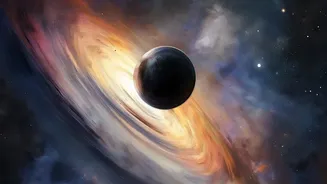
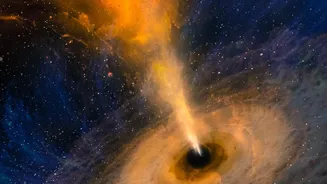
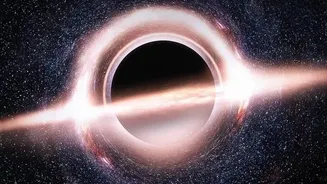
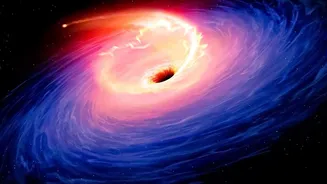
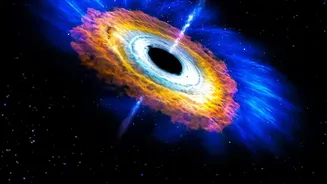
So, what is a 'black hole star'? The leading theory is that it is a massive, developing black hole, about 100,000 times the mass of our sun, wrapped in a vast, dense cocoon of hydrogen gas. Instead of being powered by nuclear fusion like a normal star, its immense luminosity comes from the black hole at its core, which violently heats the surrounding gas as it consumes it. This process creates a glowing, star-like object. Scientists have long theorized about these objects, sometimes called 'quasi-stars', believing they could have formed in the primordial universe when giant gas clouds collapsed directly into a black hole, with the outer layers remaining to form a stellar envelope.
Solving a Supermassive Mystery
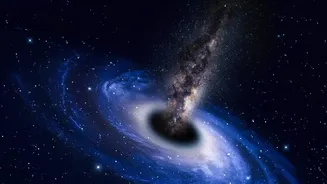
The existence of black hole stars could solve one of the biggest problems in cosmology: how did supermassive black holes get so big, so fast? Astronomers have observed black holes billions of times the mass of the sun in the very early universe, but there hasn't been enough time since the Big Bang for them to grow that large through conventional means, like merging with other stars and black holes. A black hole star provides a 'missing link'. They would act as pre-built, massive 'seeds' that could grow incredibly quickly, feeding on their own gaseous envelopes before emerging as the supermassive black holes we see at the center of nearly every large galaxy, including our own Milky Way.
The 'Little Red Dots' Connection
This discovery might also explain the other 'little red dots' that the James Webb Space Telescope has been spotting all over its deep-field images of the early cosmos. Researchers suspect that many of these mysterious objects, previously thought to be young galaxies, could in fact be black hole stars. The candidate MoM-BH-1 is exceptionally bright, allowing scientists to study it in detail, but it could be the first confirmed example of a much larger population. If true, it would mean these strange objects were a common and crucial phase in the evolution of the universe.
What Happens Next?
While the evidence is compelling, MoM-BH*-1 is still a candidate. Confirming its status as a black hole star requires further observation and analysis. Scientists will continue to use the James Webb Space Telescope to study its light spectrum and search for similar objects. Each new piece of data will help refine the models of how these objects form, live, and die, eventually leaving behind a fully-fledged supermassive black hole. This single, strange object has opened up a new frontier in our understanding of the cosmic dawn, providing a tangible clue to the formation of the universe's largest and most enigmatic structures.