





India’s Aditya-L1 mission is rewriting our understanding of the Sun’s powerful eruptions. A groundbreaking study reveals these events are not the uniform bubbles scientists once thought, a discovery crucial for protecting our technology on Earth.
India's Watchful Eye on the Sun
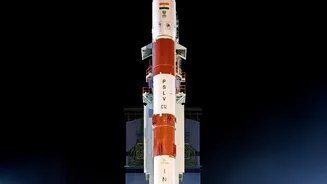
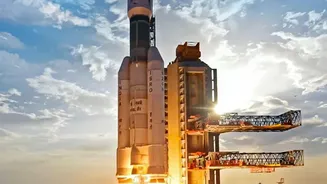
Launched
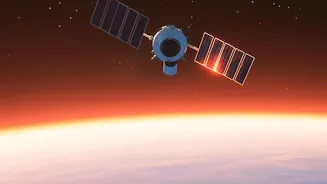
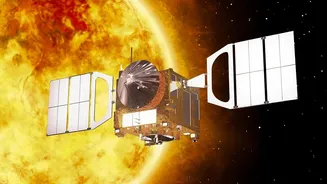
in September 2023, Aditya-L1 is the Indian Space Research Organisation's (ISRO) first mission dedicated to studying the Sun. It orbits at the first Lagrange point (L1), a gravitationally stable spot about 1.5 million kilometres from Earth, which allows it to observe the Sun continuously without interruption. The spacecraft is equipped with seven advanced payloads designed to study different layers of the Sun, from its visible surface (photosphere) and the layer above it (chromosphere) to the scorching outer atmosphere (corona). This constant vigil is essential for understanding solar phenomena that drive space weather.
A Breakthrough Observation of an Eruption
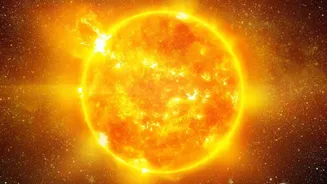
The headline-making discovery comes from a study of a Coronal Mass Ejection (CME) that occurred on August 5, 2024. CMEs are colossal explosions that hurl billions of tonnes of magnetised plasma from the Sun's corona into space. For a long time, models assumed these eruptions expanded symmetrically, like a perfect bubble. However, observations from Aditya-L1's Visible Emission Line Coronagraph (VELC) instrument told a different story. By analysing the light from the eruption, scientists at the Indian Institute of Astrophysics found that this CME expanded unevenly, developing a tilted and asymmetric shape as it travelled away from the Sun.
Decoding the Shape of Solar Storms
This discovery was made possible by VELC's unique capabilities. Unlike standard instruments that only capture a 2D image of an eruption's movement across the sky, VELC uses a technique called Doppler spectroscopy. This works like a cosmic speed gun, measuring shifts in the wavelength of light. Light from plasma moving towards the observer shifts to blue, while light from plasma moving away shifts to red. During the August 2024 event, VELC detected both blue and red-shifted light simultaneously, proving that parts of the eruption were moving towards Earth's direction while other parts moved away. This was the tell-tale signature of a complex, three-dimensional, and lopsided explosion, a finding that could not be achieved with imaging alone.
Why the Shape of an Eruption Matters
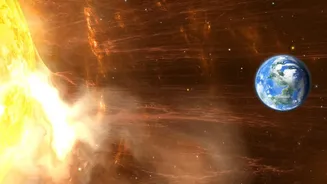
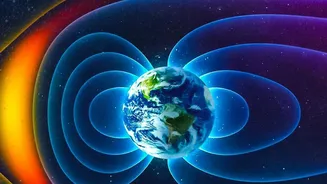
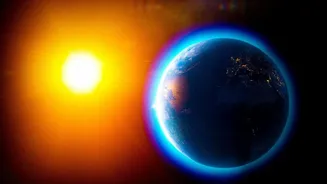
The shape of a CME is not just a scientific curiosity; it has profound implications for space weather forecasting. Space weather refers to the changing conditions in space, driven by the Sun's activity. When a CME is aimed at Earth, it can interact with our planet's magnetic field, triggering geomagnetic storms. These storms pose a significant threat to our modern, technology-dependent society. They can damage satellites, disrupt GPS navigation and radio communications, endanger astronauts, and even destabilise power grids on the ground. An asymmetrically shaped CME will interact with the solar wind differently than a uniform one, which can alter its speed and trajectory through space. Knowing the true shape helps scientists more accurately predict when a solar storm will arrive and how intense its impact might be.
A New Era for Space Weather Forecasting
This finding from Aditya-L1, published in 'The Astrophysical Journal Letters', marks a significant step forward. By combining VELC's spectroscopic data with images from NASA's Solar Dynamics Observatory and advanced 3D modelling, researchers could reconstruct the eruption's true geometry. The study confirmed that models assuming a simple, symmetric bubble failed to match the observations, whereas a model incorporating an uneven, tilted expansion was a near-perfect fit. This demonstrates Aditya-L1's power to provide a more complete picture of solar events in their critical early stages. This Indian mission is not just collecting data; it is fundamentally improving the models used globally to protect critical infrastructure from the Sun's violent outbursts.