






An Ocean of Liquid Iron
Our planet has a heart of iron. At its very center lies a solid inner core, but surrounding this is a vast, turbulent ocean of liquid iron and nickel known as the outer core. Swirling at temperatures as hot as the surface of the Sun, this layer is in constant
motion. This movement of electrically conducting molten metal is what generates Earth’s magnetic field, a process known as the geodynamo. This magnetic field acts as a protective shield, deflecting harmful solar radiation and making life on Earth possible. For decades, scientists believed the general flow within this core was relatively stable, a slow and predictable churn deep below.
How Satellites See the Unseen
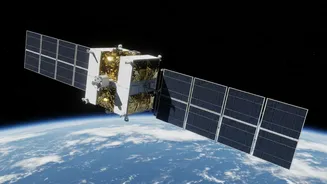
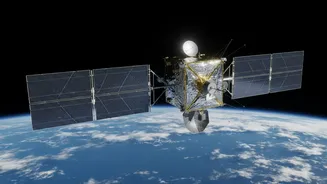
Directly observing the core, which begins some 2,900 kilometres down, is impossible. Instead, scientists rely on indirect methods. One of the most powerful tools is a trio of satellites from the European Space Agency (ESA) known as the Swarm mission. Launched in 2013, these highly sensitive spacecraft orbit the Earth, meticulously measuring our planet’s magnetic field. Because the flow of liquid iron in the core generates the magnetic field, subtle changes in the field measured at the surface can be used to infer the movement of the molten metal deep below. By separating the magnetic signals from the core from other sources like the crust and oceans, scientists can create models that map the core's dynamic behaviour.
A Sudden and Surprising Reversal
By analyzing years of data from Swarm and other missions, scientists uncovered a surprising event. A huge section of the core's flow, located deep beneath the Pacific Ocean, had dramatically changed direction around the year 2010. For years, observations suggested this area was flowing weakly westward. Suddenly, it reversed, beginning to move strongly to the east. This was not a small fluctuation; it was a rapid and large-scale reversal that challenged the long-held assumption that the core's circulation was dominated by a stable westward drift. The reasons for this abrupt change remain a mystery that scientists are actively trying to solve.
What Does This Reversal Mean?
The immediate question is whether this change poses any danger to us on the surface. The simple answer is no. These processes, while fundamental to our planet, occur on immense timescales and at extreme depths. However, the discovery is profoundly important for understanding the engine that drives our world. It provides a rare glimpse into the complex and perhaps more volatile nature of the geodynamo than previously thought. Scientists are now investigating whether this reversal is a temporary fluctuation, part of a long-term oscillation, or the beginning of a new, stable pattern of flow. More recent data suggests the eastward surge may already be weakening, hinting that it could be part of a natural cycle. This event also raises intriguing questions about potential connections between the liquid outer core and the solid inner core, whose own rotation has also shown surprising changes.