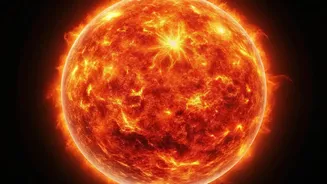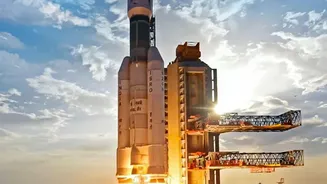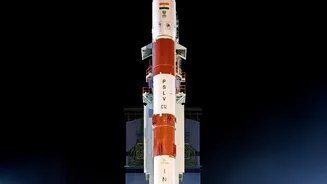





In a remarkable display of international scientific synergy, ISRO's Aditya-L1 solar observatory has helped create a stunning 3D reconstruction of a solar eruption, offering an unprecedented view of our star's violent and complex behaviour.
A New View of the Sun
India's first
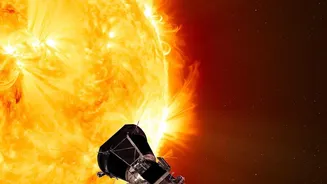
dedicated space-based solar observatory, Aditya-L1, is on a mission to continuously study the Sun from a unique vantage point 1.5 million kilometres from Earth. One of its primary goals is to understand powerful solar phenomena, particularly Coronal Mass Ejections (CMEs)—colossal explosions of plasma and magnetic fields from the Sun's outer atmosphere, the corona. These eruptions can hurl billions of tonnes of solar material into space at incredible speeds. When directed at Earth, they can disrupt satellites, cripple communication networks, and damage power grids. Understanding how they form and evolve is crucial for forecasting this 'space weather' and protecting our technology-dependent world.
The Power of Two Perspectives
Scientists from the Indian Institute of Astrophysics (IIA) in Bengaluru achieved this breakthrough by combining data from two different spacecraft. They used Aditya-L1's primary instrument, the Visible Emission Line Coronagraph (VELC), along with images from NASA's Solar Dynamics Observatory (SDO). While most telescopes capture CMEs in 2D, showing their movement across the sky, VELC does something special. It uses spectroscopy to analyse the light from the eruption, measuring how fast plasma is moving towards or away from the observer—a crucial piece of the puzzle that provides depth. By merging VELC's depth perception with SDO's high-resolution images, the team was able to build a comprehensive 3D model of a CME that occurred on August 5, 2024.
Challenging a Long-Held Assumption
For years, scientists have often modelled CMEs as symmetrical bubbles expanding uniformly outwards from the Sun. However, this joint observation has revealed a different story. The 3D reconstruction showed that the eruption did not expand evenly. Instead, it grew asymmetrically, with different parts moving at different speeds, creating a more complex, irregular shape. The research team at IIA developed a computer model to simulate the event, finding that a simple, symmetrical expansion could not explain the unique spectral data captured by VELC. Only a model that incorporated an uneven, tilted expansion could reproduce what the instruments actually saw.
Why a 3D View Matters
Seeing a CME in three dimensions is not just a scientific novelty; it has profound practical implications. The asymmetric shape of a solar eruption can significantly affect how it travels through space and interacts with the solar wind, the constant stream of particles flowing from the Sun. This, in turn, can influence the CME's speed and, most importantly, its arrival time at Earth. Previously, predicting the exact impact of a solar storm has been challenging. This new ability to reconstruct the initial shape and expansion of a CME provides vital information that can refine space weather forecasting models. More accurate predictions give satellite operators and power grid managers more time to take protective measures, mitigating potential damage.
A Milestone for Indian Science
This achievement highlights the advanced capabilities of the Aditya-L1 mission and its VELC instrument, which was developed by the IIA with support from ISRO. It demonstrates that crucial 3D information about solar eruptions can be gathered from a single vantage point when the right instruments are used, without always needing multiple spacecraft spread around the Sun. The successful collaboration between ISRO and NASA underscores the global nature of modern space science, where sharing data leads to more profound discoveries than any single agency could achieve alone. This work not only enhances our fundamental understanding of the Sun but also solidifies India's position as a key player in solar physics and space exploration.