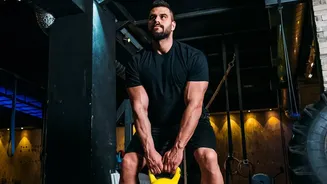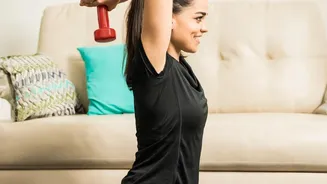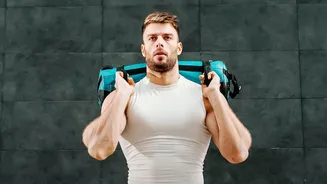




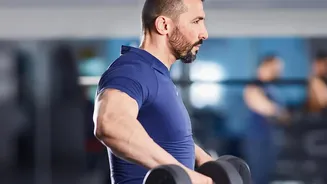
1. Kettlebell Swings
The kettlebell swing is an explosive, rhythmic movement, making it a perfect match for music. The exercise involves a powerful hip-hinge, not a squat, to drive the bell forward and up. This pendulum-like motion has a natural cadence that can be easily
synchronized with a song's beat. Find a track with a strong, clear downbeat around 100-120 beats per minute (BPM). Focus on snapping your hips forward precisely on each beat. This transforms the exercise from a simple movement into a power-building dance. The music provides an external cue that helps maintain a consistent pace and encourages the explosive drive needed for a perfect swing, helping to improve your coordination and make the set feel more engaging.
2. Goblet Squats
The squat is a foundational strength move, and music can significantly enhance your form and intensity. The tempo of a song can dictate the speed of your repetitions. For building strength and control, choose a slower track. Use the beat to time your descent, perhaps taking two to four counts to lower yourself down, and then exploding up on a single count. This method, known as tempo training, increases the muscle's time under tension, leading to greater strength gains. For a more endurance-focused challenge, a faster song can push you to complete more reps. In either case, the rhythm acts like a metronome, ensuring consistency in every single squat.
3. Push-Ups
Much like the squat, the classic push-up can be transformed by a good beat. The simple up-and-down motion is ideal for syncing with music. You can align your movement with the rhythm by lowering your chest to the floor on one beat and pushing back up on the next. For an added challenge, try changing the tempo. Use a slower song to focus on the negative (lowering) phase of the movement, which helps build muscle and control. A faster tempo can be used for burnout sets at the end of a workout. Synchronizing your push-ups to music can distract from the feeling of exertion, helping you push past your usual limits and complete more repetitions than you thought possible.
4. Glute Bridges
The glute bridge is a fantastic exercise for activating your posterior chain, and music helps you make every rep count. The primary movement—a powerful hip thrust—can be performed directly on the strongest beat of a song. This creates an undeniable mind-muscle connection, helping you focus on squeezing your glutes at the top of the movement. You can also play with the tempo by holding the bridge for a set number of beats before lowering back down. Using a song with a consistent and driving rhythm encourages a steady, powerful pace, making the exercise more effective and less monotonous.
5. Renegade Rows
This advanced exercise combines a plank with an alternating dumbbell row, challenging your core stability, back, and arms. The sequence of movements—plank, row right, plank, row left—lends itself well to a four-beat musical measure. This rhythmic coordination can help you maintain strict form, preventing your hips from rotating and ensuring your core remains braced. Finding a steady, moderate-tempo track allows you to create a smooth, controlled flow from one side to the other. The beat acts as a guide, keeping your movements deliberate and preventing you from rushing, which is a common mistake that reduces the exercise's effectiveness and increases injury risk.