

A Cosmic Crowd
In a galaxy designated J0148-4214, so distant that we see it as it was just 1.2 billion years after the Big Bang, an international team of astronomers has made a landmark discovery. Using the powerful infrared vision of the James Webb Space Telescope
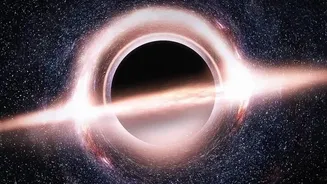
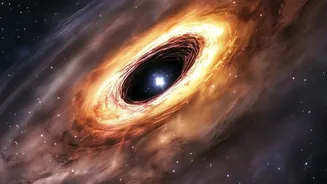
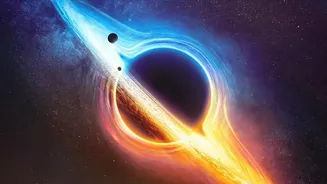
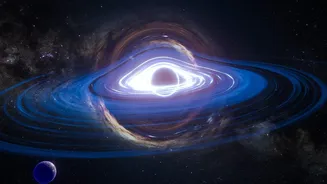
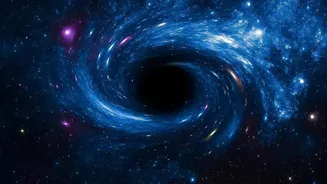
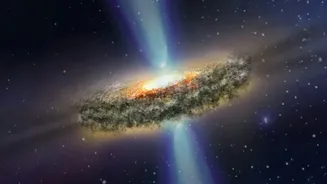
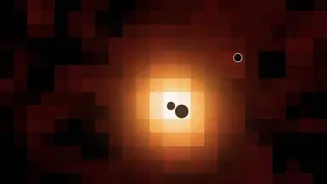
(JWST), they identified three supermassive black holes all actively feeding within this single ancient galaxy. This is the first time such a trio has ever been confirmed in the distant universe. Two of the black holes are huddled close to the galaxy's center, separated by a mere 620 light-years, while a third lies further out. Finding even two black holes on the verge of merging is rare, but finding three together provides an extraordinary snapshot of the violent and chaotic processes that shaped the earliest galaxies.
Hunting for Ancient Monsters
The discovery was the result of a dedicated observing program designed to hunt for black holes in the early universe. Astronomers pointed the JWST at J0148-4214, a galaxy previously flagged as being extremely distant. Using the telescope's advanced spectroscopic instruments, the team, led by researchers from the Max Planck Institute for Extraterrestrial Physics, could analyze the light coming from the galaxy's core. They detected the tell-tale signs of fast-moving hydrogen gas, which revealed the presence of not one, but three distinct, actively accreting black holes — meaning they are all voraciously consuming surrounding gas and dust. The data was so detailed that scientists could even estimate their masses, which range from 0.6 million to 80 million times the mass of our sun.
Rewriting the Story of Galaxies
This discovery offers a compelling solution to one of cosmology's most persistent puzzles: how did supermassive black holes get so big, so fast? The black holes that power brilliant quasars in the early universe grew to billions of solar masses in under a billion years, a timeline that has been difficult to explain. The leading theory is that they grew through a series of mergers. As young, small galaxies collided and combined, their central black holes would have sunk to the center of the new, larger galaxy and eventually merged. The trio in J0148-4214 is a direct observation of this process in action. It suggests these galactic pile-ups were an efficient way to bring massive black holes together, providing a rapid growth channel that models have long predicted.
A Glimpse of the Dawn
The era in which we see this galaxy, roughly 500 million to 1 billion years after the Big Bang, is known as the Cosmic Dawn. This was a transformative period when the universe, long shrouded in darkness after its initial expansion, was lit up for the first time by the formation of the first stars and galaxies. Their intense light began to burn through the primordial fog of neutral hydrogen gas in a process called reionization. Discoveries from this epoch are crucial because they allow us to test theories about how structure in the universe first emerged. Observing a complex system like a black hole trio in this early period is a significant achievement, offering a rare look at the dramatic events that set the stage for the universe we see today.