



More Than Just a Flash
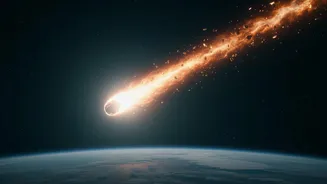
For most of us, a meteor is a beautiful, momentary flash—a 'shooting star' that vanishes as quickly as it appears. But for scientists, that brilliant streak is a data-rich event. On August 3, 2026, a NASA camera part of the All Sky Fireball Network, captured
a particularly vivid meteor slicing through the atmosphere. While the image itself is spectacular, its true value lies in what it tells us about the meteor's composition as it burns up tens of kilometres above our heads. This process of disintegration isn't just destruction; it's a cosmic chemical analysis in action. The intense heat of atmospheric entry, reaching thousands of degrees, vaporises the tiny rock, releasing a cloud of superheated gas and atoms. It's this glowing trail of vaporised material that scientists can read like a book.
Decoding the Meteor's Rainbow
The key to understanding the meteor's makeup is a technique called spectroscopy. Think of how a prism splits white light into a rainbow. Spectroscopy does something similar for the light from a meteor. As the meteor's elements vaporise, they don't just glow; they emit light at very specific colours, or wavelengths. Each chemical element, whether it's iron, sodium, or magnesium, has a unique 'fingerprint' of light that it gives off when heated. By using a special instrument called a spectroscope—essentially a camera with a diffraction grating—scientists can capture the light and break it down. The resulting spectrum shows bright lines of colour that correspond directly to the minerals vaporising from the meteoroid, telling researchers exactly what it was made of.
The Colours of the Cosmos
So what do these colours reveal? A flash of orange often points to the presence of sodium, similar to the glow of a sodium-vapour streetlamp. A bright green hue is a tell-tale sign of magnesium, while iron typically produces a yellow-white light. Many meteors are fragments of asteroids and are broadly classified into stony, iron, or stony-iron types. Stony meteoroids, rich in silicates, and those containing iron and nickel, all produce different spectral signatures. By analysing the intensity of these different colours in the August 3rd image, scientists can estimate the relative abundance of these elements. This helps them not only identify the meteor's parent body but also understand the chemical processes that have shaped these cosmic travellers over billions of years.
Why Vaporising Minerals Matter
Analysing these cosmic ingredients provides a direct window into the building blocks of our solar system. Meteoroids are remnants from the formation of planets, asteroids, and comets. Some contain minerals like iron sulfide, which studies show vaporises at high heat, leaving voids and making the object more porous. Others, like recent samples from the asteroid Bennu, have revealed sodium-rich salts that suggest the presence of ancient salty water on their parent asteroid. By studying the stuff that meteors are made of, we can piece together the history of water, organic compounds, and essential elements across the solar system. Each meteor that vaporises in our atmosphere is a tiny, fleeting science experiment, offering clues about our own origins.
Your Turn to Watch
This new image arrives just in time for one of the year's best celestial events for skywatchers in India and across the Northern Hemisphere: the Perseid meteor shower. Peaking around August 12-13, the Perseids are known for producing bright meteors—and even fireballs—at a rate of 50 to 100 per hour under dark skies. This year is particularly special as the peak coincides with a new moon, meaning the sky will be perfectly dark for viewing. While the monsoon clouds could be a challenge for many in India, high-altitude, arid regions like Ladakh, Spiti Valley, or the Rann of Kutch offer the best chances for a clear view. No telescope is needed; just find a dark spot away from city lights, let your eyes adjust for about 20-30 minutes, and look up. The best viewing is typically after midnight and into the pre-dawn hours.