



A New Eye on the Cosmos
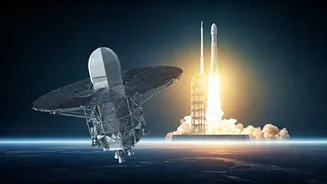
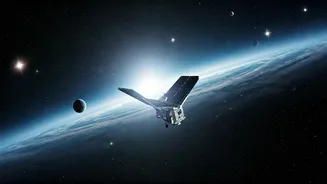
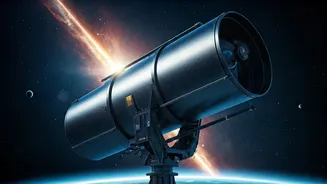
Scheduled for a highly anticipated launch on August 30, 2026, the Nancy Grace Roman Space Telescope is NASA's next great observatory. Named after the agency's first Chief of Astronomy, Nancy Grace Roman, who is often called the 'mother of Hubble', this
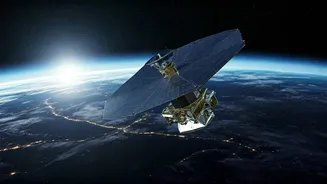
mission is designed to tackle some of the biggest questions in astrophysics. While its primary mirror is the same size as the Hubble Space Telescope's—2.4 meters in diameter—Roman is built for a different purpose: speed and scale. Its cutting-edge Wide Field Instrument will provide a field of view at least 100 to 200 times larger than Hubble's, allowing it to map vast stretches of the sky with incredible speed and efficiency. Think of it as the difference between examining a single grain of sand with a magnifying glass and taking a high-resolution panoramic photo of the entire beach. Both are useful, but Roman's goal is to capture the big picture.
What is a Cosmic Atlas?
The idea of a "cosmic atlas" refers to the telescope's ambitious survey programs designed to map the universe in unprecedented detail. These aren't just static images; they will be multi-layered maps revealing the distribution of stars, galaxies, and the invisible structures that dominate the cosmos. The mission's primary surveys include the High-Latitude Wide-Area Survey, the High-Latitude Time-Domain Survey, and the Galactic Bulge Time-Domain Survey. Together, these efforts will measure the light from over a billion galaxies and observe thousands of exploding stars, or supernovae. By charting the precise locations and properties of these celestial objects across cosmic time, Roman will effectively create a 3D map that shows how the universe has evolved. This atlas will be a foundational resource for astronomers for decades, much like historical maps were for explorers of old.
Charting the Universe's Dark Side
Two of the most profound mysteries in science are dark energy and dark matter. Together, they are believed to make up about 95% of the universe, yet we can't see them directly. Roman is specifically designed to hunt for their effects. The High-Latitude Wide-Area Survey will map the shapes and positions of hundreds of millions of galaxies. By studying the subtle ways their light is bent by gravity—a phenomenon called weak gravitational lensing—scientists can infer the location of invisible dark matter. At the same time, the High-Latitude Time-Domain Survey will detect tens of thousands of Type Ia supernovae. These exploding stars act as 'standard candles' with a known brightness, allowing astronomers to precisely measure their distance and calculate the expansion rate of the universe. By tracking this expansion over time, Roman will provide crucial data on the nature of dark energy, the mysterious force causing the universe's expansion to accelerate.
A Galaxy of New Worlds
Beyond cosmology, Roman is poised to revolutionize the hunt for exoplanets—planets orbiting other stars. Instead of looking for the dimming of a star's light as a planet passes in front (the transit method), Roman will primarily use a technique called gravitational microlensing. This method detects the way a foreground star and its planets act as a lens, briefly magnifying the light from a more distant background star. This technique is sensitive enough to find planets with masses as low as sub-Earth and even free-floating planets that have been ejected from their home systems. The Galactic Bulge Time-Domain Survey will stare at the dense starfield at the center of our Milky Way, expecting to discover thousands of new exoplanets and create the first statistical census of planetary systems throughout our galaxy.
The Legacy of a New Map
Like the great observatories before it, the Roman Space Telescope is not just a tool for answering today's questions; it's a discovery engine for questions we haven't even thought to ask yet. By conducting vast, open-access surveys, it will generate a treasure trove of data that will be mined by scientists for generations. Its wide-angle view will complement the deep, focused gaze of telescopes like Hubble and the James Webb Space Telescope, providing context and identifying new targets for closer study. Having recently arrived at Kennedy Space Center in Florida, the telescope is undergoing final preparations for its launch. When it begins its five-year primary mission from its vantage point a million miles from Earth, it will begin compiling an atlas that will not only redraw our maps of the cosmos but fundamentally deepen our understanding of our place within it.