






A Cosmic Origin Story
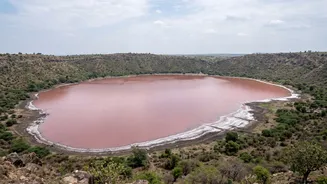
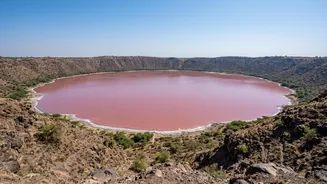
Before we dive into the colour, it's important to understand that Lonar Lake is no ordinary body of water. Located in Maharashtra's Buldhana district, it is the Earth's only hyper-velocity impact crater in basaltic rock. Around 52,000 years ago, a meteor
slammed into the Deccan Plateau, creating a massive depression that is nearly 1.8 kilometres wide and 150 metres deep. This cosmic event created a closed, self-contained ecosystem. Over millennia, rainwater filled the crater, but with no outlet, the water became both saline (salty) and highly alkaline over time, setting the stage for its future transformations.
The Pink Culprit Revealed
The primary reason for the lake's dramatic pink makeover is a microscopic organism. Scientific investigations, particularly by the Agharkar Research Institute, have confirmed that the colour comes from a massive population of salt-loving bacteria known as 'Haloarchaea'. These microbes, a type of archaea, thrive in water with extremely high salt concentrations. They produce a pink-red pigment called carotenoids as part of their cellular structure. When conditions are just right, these bacteria multiply rapidly, creating a dense, pink-coloured mat across the water's surface, which makes the entire lake appear pink.
The Perfect Recipe for Pink
So, what triggers this bacterial bloom? It’s a combination of three key factors. First is high salinity. During dry, hot periods with little rainfall, water from the lake evaporates, causing the salt concentration to increase significantly. Second is high alkalinity; the lake naturally has a high pH, around 10.5, which is an environment where these specific microbes flourish. The third factor is temperature and sunlight. Warmer temperatures accelerate evaporation and provide the energy these organisms need to multiply. In essence, when water levels drop and salinity and pH rise during the pre-monsoon summer months, the conditions become perfect for a 'Haloarchaea' population explosion, and the lake blushes pink.
A Cycle of Wonder
The pink phenomenon is not a permanent state. Once the monsoon season arrives, the influx of fresh rainwater begins to dilute the lake. This dilution lowers the salinity and pH levels, making the environment less favourable for the Haloarchaea. As their population subsides, the pink hue fades, and the lake's more typical greenish colour returns, which is often caused by the presence of other microorganisms like green algae that thrive in less saline conditions. This cyclical change has happened before, but the intensity can vary from year to year, depending on the severity of the dry season.
More Than Just a Pretty Lake
Lonar Lake's significance extends far beyond its shifting colours. It is a designated National Geo-heritage Monument and, as of 2020, a Ramsar site, acknowledging its international importance as a wetland. The unique ecosystem supports a variety of flora and fauna adapted to its saline and alkaline conditions. The lake is also a point of interest for flamingos, whose pink plumage is derived from the carotenoid-rich food they eat, including the very bacteria that colour the lake. Surrounded by ancient temples, the crater is a blend of scientific marvel, ecological treasure, and cultural heritage, drawing researchers and tourists from around the globe.