


A Famous Celestial Stage
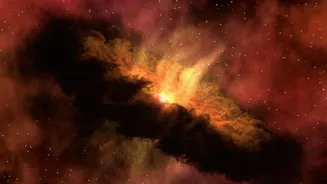
Imagine a star system in its awkward teenage years. At only 23 million years old, Beta Pictoris is a cosmic infant compared to our 4.6-billion-year-old Sun. This youth is exactly why scientists are so fascinated by it. The star is surrounded by a massive,
glowing disk of dust and debris—the raw material left over from planet formation. For decades, this disk has offered an unparalleled glimpse into how solar systems are born. Inside this dusty environment, astronomers had already found two massive gas giant planets, named Beta Pictoris b and Beta Pictoris c. The first, planet b, was a landmark discovery, as it was one of the very first exoplanets to ever be directly photographed.
The Two Giants We Knew
The existing planets in the system were already a source of immense study. Beta Pictoris b, about ten times the mass of Jupiter, orbits its star at a distance similar to Saturn in our own solar system. Its sibling, Beta Pictoris c, is slightly less massive and orbits much closer, at a distance comparable to our asteroid belt. Planet c was discovered using a different, indirect method that measured the gravitational wobble it induced on its parent star, before it was also directly imaged a year later. With two confirmed giants, the system was considered a textbook example of planetary evolution. Scientists thought they had a good handle on its layout, but the system's story was far from complete.
Enter a Third World: Beta Pictoris d
In a stunning announcement in mid-2026, two independent teams of astronomers revealed they had found a third planet: Beta Pictoris d. This was no minor addition. The discovery makes Beta Pictoris only the second star system known to have three directly imaged planets, cementing its status as a prime target for study. This new world is also a gas giant, but it’s the runt of the litter, estimated to be about two or three times the mass of Jupiter, making it significantly smaller than its siblings. It orbits much farther out, taking nearly a century to complete one lap around its star. The real surprise, however, wasn't just that it existed, but how it had managed to stay hidden for so long.
How It Was Hidden in the Glare
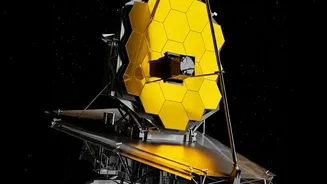
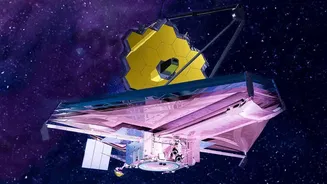
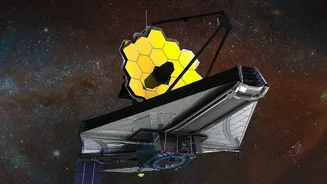
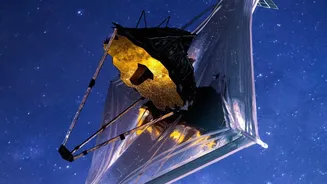
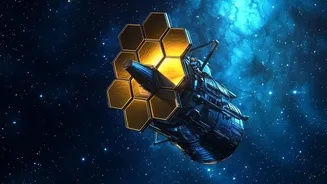
Beta Pictoris d was the ultimate cosmic wallflower, concealed by the overwhelming glare of its star and the thick, foggy debris disk. One team, using the powerful James Webb Space Telescope (JWST), didn't find it by looking for a point of light. Instead, they used a sophisticated spectroscopic technique that filtered out the disk's dusty noise and detected the unique chemical fingerprint of the planet's atmosphere. Independently, another team using the European Southern Observatory's Very Large Telescope (VLT) spotted a faint object. Digging back into archival data, they were shocked to find that faint traces of the planet had been captured in observations stretching back more than a decade, completely overlooked until now.
A New Toolkit for Planet Hunters
The discovery by the JWST team is particularly revolutionary. Finding a planet by decoding the chemical signals from its atmosphere, rather than relying on direct imaging, is a game-changer. This method allows astronomers to find worlds buried in complex and messy environments that would otherwise be invisible. It proves that we can identify exoplanets not just by seeing them, but by sensing their atmospheric breath from light-years away. This opens up a new frontier in the search for planets around other stars, promising to reveal worlds that have so far eluded more traditional detection techniques.
Solving a Long-Standing Cosmic Puzzle
The existence of Beta Pictoris d isn't just a fun fact; it helps solve a puzzle that has bothered astronomers for years. Scientists have long wondered about the specific structure of the star's debris disk, particularly its sharply defined inner edge. The gravitational influence of a third, more distant planet was a leading theory to explain this, and now Beta Pictoris d appears to be the culprit. Its presence helps explain how the system's architecture was sculpted, providing a crucial piece of the planet-formation puzzle. By studying three planets that all formed from the same material around the same star, scientists can now draw even more detailed conclusions about how planetary systems evolve.