





Why Water Is the New Space Gold
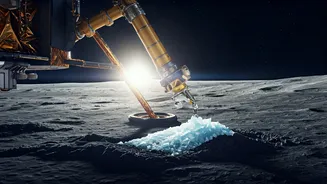
For decades, the Moon was considered a bone-dry desert. But discoveries, including crucial data from India's Chandrayaan-1, have confirmed the presence of water, particularly in the form of ice hidden in permanently shadowed craters at the lunar poles.
This has ignited a new wave of excitement because water is the most critical resource for future space exploration. It's not just for drinking. Through a process called electrolysis, water (H₂O) can be split into hydrogen and oxygen. Oxygen provides breathable air for astronauts, and both hydrogen and oxygen are powerful rocket propellants. The ability to refuel on the Moon would be a game-changer, transforming it from a simple destination into a refuelling station and launchpad for missions deeper into the solar system, including Mars. This concept, known as in-situ resource utilization (ISRU), is at the heart of the current lunar push, promising to dramatically lower the cost of space travel by reducing the need to haul heavy resources up from Earth.
More Than Just Water: Meet the Volatiles
The missions are not just looking for water. They are prospecting for 'volatiles,' which are compounds that can be easily vaporized. On the Moon, these include not only water ice but also other elements and compounds trapped in the frigid lunar soil, or regolith, like hydrogen, helium, and carbon compounds. These materials are valuable for both science and sustenance. They can tell us about the history of the solar system and the origin of water on Earth and the Moon. More practically, they represent a treasure trove of potential resources. For example, some lunar regolith contains Helium-3, a rare isotope with potential applications in future nuclear fusion reactors for clean energy production. By mapping these volatiles, space agencies and private companies are essentially creating a resource map for future lunar settlement and industry.
The Robotic Prospectors
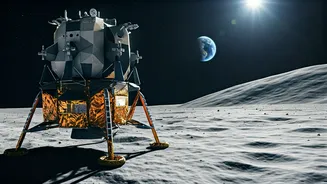
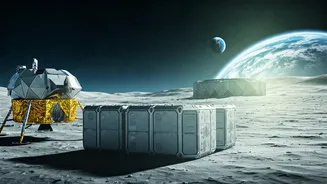
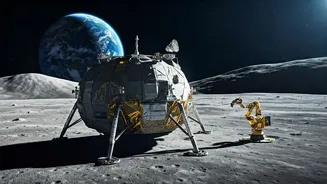
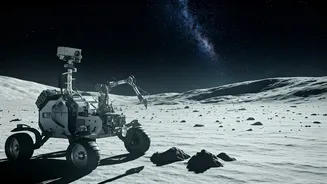
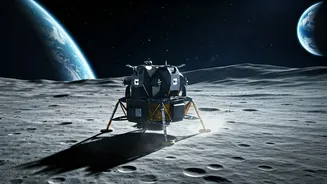
A new wave of missions is set to deploy rovers and landers equipped to find and analyze these hidden resources. China's Chang'e-7 mission, planned for 2026, aims to explore the South Pole for water ice using a lander, rover, and even a small flying detector to access hard-to-reach areas. NASA, through its Commercial Lunar Payload Services (CLPS) initiative, is funding a fleet of private companies to deliver science and technology to the lunar surface. Companies like Astrobotic, Intuitive Machines, and Firefly Aerospace are slated for missions in the coming years, carrying instruments to measure volatile compounds and quantify subsurface ice. After being cancelled, NASA's VIPER rover, designed specifically to map water ice, has been revived and is now planned to fly with Blue Origin to the lunar South Pole in 2027. The European Space Agency (ESA) is also in the game with its Prospect mission, which will drill up to a meter below the surface to search for samples.
India's Stake in the Lunar Game
India is a key player in this international effort. Building on the legacy of its Chandrayaan missions, which were pioneers in lunar water detection, ISRO is collaborating with Japan's JAXA on the Lunar Polar Exploration (LUPEX) mission. Targeted for no earlier than 2028, LUPEX will feature a rover equipped with instruments from both agencies, including a NASA-provided Neutron Spectrometer System (NSS) designed to detect hydrogen—a tell-tale sign of water—beneath the surface. This mission will conduct detailed on-site analysis of water distribution and quality. The goal is to understand the resource potential to support a long-term human presence. India's continued focus on lunar exploration not only enhances its scientific standing but also positions it to be a significant partner in the emerging cislunar economy, where access to lunar resources will be a key strategic advantage.