







A World of Continuing Surprises
For decades, Pluto was little more than a faint speck of light in our most powerful telescopes. That all changed in July 2015 when NASA's New Horizons spacecraft flew past the dwarf planet, revealing a world of stunning complexity. Instead of a simple,
frozen, and inert ball of ice, we saw towering mountains of water ice, vast glaciers of frozen nitrogen, and a surprisingly dynamic atmosphere. The centerpiece of this new portrait was Tombaugh Regio, the famous heart-shaped feature on Pluto's surface. One of the most fascinating areas within this feature is Sputnik Planitia, a massive basin of nitrogen ice larger than Texas and Oklahoma combined. It's here, more than a decade after the flyby, that scientists are still unearthing secrets from the data, with the latest discovery being the most unexpected yet.
The Telltale Signs of Liquid
The new evidence comes from a fresh analysis of images of the northern part of Sputnik Planitia. These images show city-sized cells of ice that are separated by thin, dark lines and other diffuse dark patches. Scientists now believe these features are signs of liquid nitrogen occasionally and temporarily wetting the surface. The appearance of these dark features closely resembles what happens on glaciers here on Earth, such as on the Greenland ice sheet, where meltwater darkens the surface of the ice and snow. Given that Pluto's thin atmosphere and extreme cold make nitrogen rain a physical impossibility, the liquid must be coming from somewhere else: below the surface.
How Can Liquid Exist on Pluto?
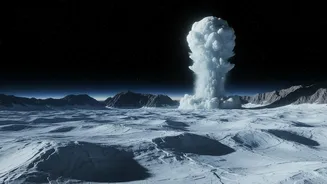
The idea of liquid on Pluto, where surface temperatures hover around minus 230 degrees Celsius, seems impossible. However, the new study, published in the Planetary Science Journal, proposes a compelling mechanism. Computer models suggest that beneath the kilometers-deep Sputnik glacier, the immense pressure could be enough to melt the nitrogen ice at its base, creating reservoirs of liquid nitrogen. This liquid nitrogen, being less dense than the solid ice above it, would then be forced upward through cracks and fissures, much like magma in a volcanic system on Earth. Driven by this buoyancy and pressure from below, the liquid nitrogen could erupt onto the surface in short, intense pulses. Once on the surface, it would briefly flow and wet the icy ground before refreezing, creating the darkened patterns observed by New Horizons.
A Geologically Active World
This discovery is the first strong evidence of recently flowing liquid on Pluto's surface and reinforces the idea that the dwarf planet is not a static, frozen world. It suggests that Pluto has an ongoing, active geology, with subsurface processes capable of reshaping its landscape. The existence of these features implies that such eruptions could be a time-variable phenomenon, meaning the face of Pluto might be changing, even today. "Pluto never stops surprising us," said Alan Stern, the principal investigator for the New Horizons mission. This process is a form of cryovolcanism—volcanoes that erupt volatile substances like nitrogen, water, or methane instead of molten rock. Evidence for past cryovolcanism has been mounting, but these findings point to a much more recent, and potentially ongoing, process.