





The Universe’s Missing Ingredient
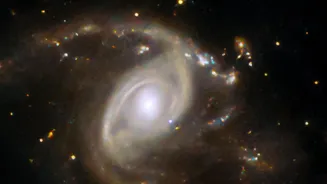
Imagine trying to understand a recipe where 85% of the ingredients are invisible. That’s the challenge astronomers face. We can see stars, planets, and galaxies, but when we measure how galaxies spin and how they cluster together, the numbers don't add
up. Galaxies rotate so fast that the gravity from their visible matter shouldn't be enough to hold them together; they should fly apart. The only way to explain this is if there’s a huge amount of unseen mass providing the extra gravitational glue. Scientists call this mysterious substance 'dark matter' because it doesn’t seem to interact with light or any other form of radiation, making it completely invisible to our telescopes. Its presence is only inferred through its gravitational pull on the things we can see.
A Promising Candidate: Primordial Black Holes
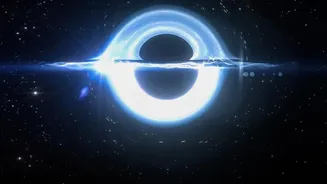
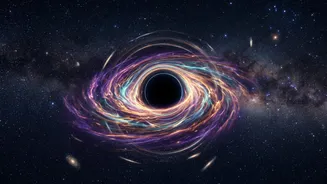
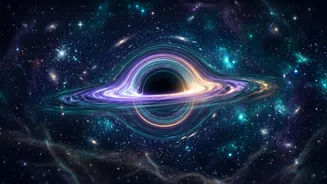
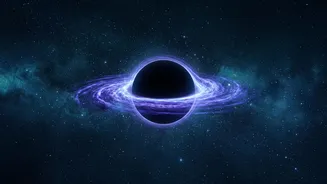
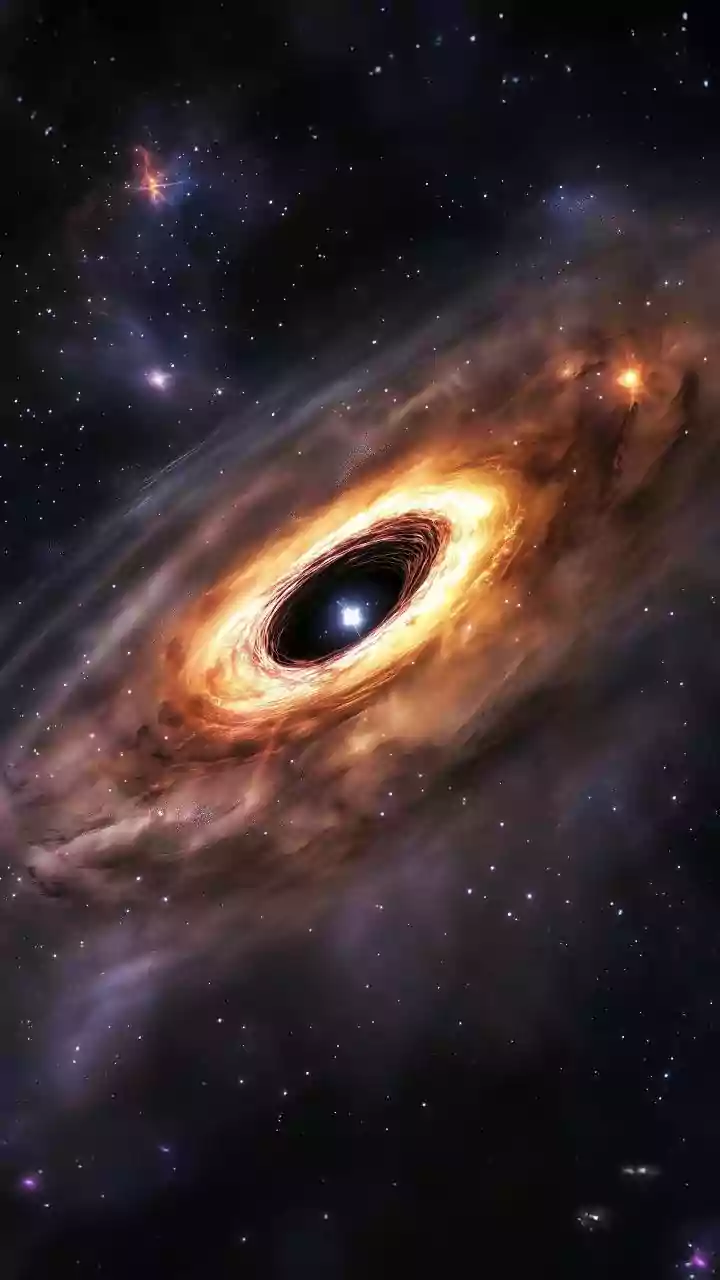
If dark matter is invisible and massive, what could it be? For a long time, a leading candidate was a hypothetical object called a Primordial Black Hole, or PBH. This idea, explored by Stephen Hawking in the 1970s, suggests that in the chaotic moments after the Big Bang, some incredibly dense pockets of matter could have collapsed directly into black holes. Unlike the black holes we know today, which form from the collapse of giant stars, these PBHs could come in a huge range of sizes, from the mass of an asteroid to thousands of times the mass of our sun. They were an almost perfect candidate for dark matter: they were formed early in the universe, they don't emit light, and they are very massive. The theory was simple and didn't require inventing new exotic particles.
How to Hunt for Invisible Black Holes
So, if PBHs are out there, how would we find them? You can't see them directly, but you can see their effects. The key is a phenomenon called gravitational microlensing. According to Einstein's theory of relativity, a massive object bends the fabric of spacetime around it. If a PBH were to pass almost directly in front of a distant star, its gravity would act like a magnifying glass, briefly bending and focusing the star's light, causing it to appear brighter for a short period. By monitoring millions of stars for these tell-tale brightening events, scientists can calculate how many massive, compact objects like PBHs are drifting through our galaxy.
The Verdict from Massive Sky Surveys
This is exactly what several large-scale astronomy projects have done. Surveys like the Optical Gravitational Lensing Experiment (OGLE) and the MACHO project have spent years staring at the sky, watching for these fleeting microlensing events. More recently, a team using Japan's Subaru Telescope conducted an extremely sensitive search by observing the neighboring Andromeda galaxy. If PBHs made up a significant fraction of dark matter, these surveys should have detected a large number of such events. But they didn't. While a handful of events have been recorded, the number is far, far lower than what would be expected if PBHs were the main component of dark matter. The results from the Subaru Telescope survey, for example, concluded that PBHs could make up no more than 0.1% of all dark matter.
Back to the Drawing Board
This doesn't mean primordial black holes don't exist at all. They might be out there, contributing a tiny fraction to the overall dark matter picture. However, the evidence strongly indicates they are not the primary solution to this cosmic puzzle. Ruling out a major candidate, while disappointing for some, is a crucial part of the scientific process. It allows researchers to narrow the field of possibilities. The focus now shifts back to other leading candidates, particularly hypothetical particles like WIMPs (Weakly Interacting Massive Particles) and axions. These particles are predicted by theories that extend the Standard Model of particle physics, but they have proven incredibly difficult to detect. The hunt for dark matter is now more challenging, but also more focused.