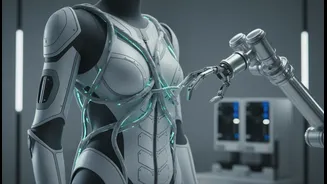










The Challenge with Wearable Robots
For years, the idea of robotic clothing and exoskeletons has been a staple of science fiction, promising to enhance our strength, assist with mobility, and protect us from harm. In the real world, however, the technology has been clunky. Most wearable
robots rely on rigid motors, gears, and frames. While powerful, these components can be heavy, cumbersome, and inherently risky, especially around the delicate and complex joints of the human body like elbows and knees. A wrong move or a system malfunction could lead to pinching, bruising, or more serious injury. This rigidity has limited the practical, everyday applications of robotic garments, keeping them largely confined to controlled environments like rehabilitation clinics and research labs.
A Solution Inspired by Nature
Researchers are now turning to a softer, more organic approach inspired by nature. A team of engineers from South Korea's KAIST and Stanford University in the U.S. have developed a groundbreaking technology using soft, flexible "vines" embedded within clothing. These are not made of plant matter, but of thin, pliable tubes that 'grow' when filled with pressurised air. This concept, often called a vine robot, works by turning the tube material inside out from its tip, allowing it to extend and navigate complex paths without friction. Instead of a rigid machine forcing movement, these soft actuators gently guide the fabric, conforming to the wearer's body like a climbing ivy plant.
How Air Power Creates Movement
The mechanics are both simple and ingenious. The 'vines' are essentially pneumatic actuators. When low-pressure air is pumped into them, the folded material at the tip unfurls, causing the vine to lengthen and advance. When the air is released, it can be retracted. By embedding these vines into a garment, engineers can control its movement with remarkable precision. For example, a jacket equipped with this technology could autonomously slide up a person's arms and torso. The lead author of a recent study was inspired when caught in the rain on his bike, imagining a raincoat that could put itself on. Because the entire system is soft and air-powered, it lacks the dangerous pinch points of traditional robotics, making it fundamentally safer for close human contact.
The Breakthrough in Safety and Usability
This shift from rigid to soft robotics is a major breakthrough for safety. The vine-like structures can move along the body, even through narrow gaps, without requiring the person to remain perfectly still. This is a huge advantage over systems that need complex control algorithms and stationary users. The soft materials mean the garment can conform to any body shape, providing support or assistance without creating uncomfortable pressure points. This inherent safety and adaptability are crucial for applications involving vulnerable users, such as the elderly or people with disabilities, and opens the door for robotic clothing to finally become a practical reality in daily life.
Future Applications: From Healthcare to the High Street
The potential applications for this technology are vast and transformative. In healthcare, it could lead to self-dressing garments for individuals with limited mobility, or soft exosuits that assist with physical therapy and rehabilitation after a stroke. Emergency workers could use it to quickly don protective equipment without using their hands. But the vision extends beyond purely functional uses. The same technology could be integrated into fashion to create adaptive clothing that changes shape or style, or performance wear for athletes that provides muscle support on demand. As the technology becomes more refined and less expensive, we could see robotic assistance woven into the very fabric of our lives.