


A Cosmic Crowd in the Early Universe
In a galaxy catalogued as J0148-4214, an international team of astronomers has identified a remarkable cosmic arrangement. We are seeing this galaxy as it was just 1.2 billion years after the Big Bang, a time when the universe was still in its infancy.
Inside this single system, scientists found compelling evidence for not one, but three supermassive black holes all actively consuming surrounding gas and dust. Two of the black holes are located close together near the galaxy's center, separated by a projected distance of only about 620 light-years, while a third lies further out in the galaxy's periphery. This discovery marks the first time a trio of active black holes has been confirmed in a single galaxy so early in cosmic history.
How the Webb Telescope Uncovered the Trio
This discovery would have been impossible without the advanced capabilities of the James Webb Space Telescope (JWST). Specifically, astronomers used the Near-Infrared Spectrograph (NIRSpec) and its powerful Integral Field Unit. This instrument doesn't just take a picture; it captures a spectrum for every single pixel in its field of view, creating a detailed 3D data cube. This allowed the team, led by researchers from the Max Planck Institute for Extraterrestrial Physics, to map the movement of gas within the distant galaxy. Without NIRSpec's ability to spatially resolve the different sources of light, the complex signals from the three black holes would have blended together, likely appearing as just a single, larger active black hole.
Reading the Hydrogen Light
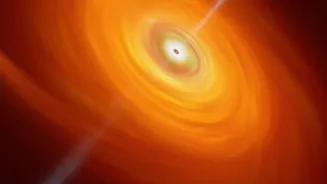
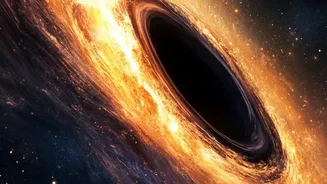
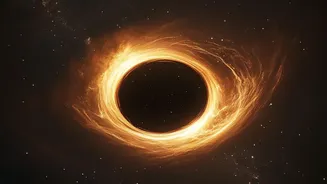
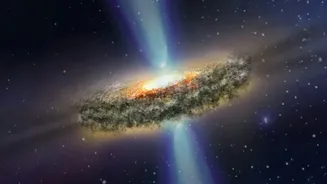
The key to spotting these cosmic engines was hydrogen gas. As matter falls into a black hole, it forms a swirling, superheated accretion disk. The intense gravitational forces and friction cause gas in this disk to move at incredible speeds, sometimes thousands of kilometers per second. This rapid motion affects the light emitted by the gas. Using NIRSpec, astronomers looked for a specific signature in the hydrogen light, known as a 'broad emission line'. The frantic motion of the hydrogen atoms broadens the specific wavelength of light they emit, a clear tell-tale sign of an active galactic nucleus (AGN), the luminous center powered by a supermassive black hole. The team detected three distinct broad-line signatures, each corresponding to a different active black hole.
Rewriting the Rules of Galaxy Growth
Finding a black hole trio this early in the universe is a major disruption to long-held theories of galaxy formation. A central puzzle in astrophysics is how supermassive black holes grew to be millions or billions of times the mass of our sun so quickly after the Big Bang. The standard model involves galaxies merging, allowing their central black holes to eventually combine. The discovery of J0148-4214 suggests this process might be far more common and chaotic than previously thought. It provides direct evidence that multiple mergers can happen in a crowded environment, rapidly assembling massive structures and fueling black hole growth. It suggests that the 'seeds' of today's giant galaxies were built through frantic, multiple collisions in the early cosmos.