


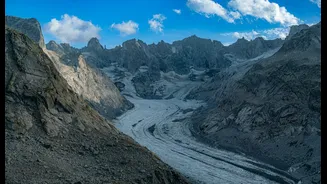
A Green Secret Under the Ice
Imagine drilling nearly a mile through solid ice in Greenland and, instead of hitting just rock and sand, pulling up a core of frozen soil containing perfectly preserved twigs, leaves, and moss. That's precisely what happened in a series of remarkable
discoveries that are changing our understanding of polar history. In one instance, a sediment core drilled by the US Army in 1966 and forgotten in a freezer for decades was rediscovered in 2017. Scientists were astonished to find not a barren landscape, but the remnants of a green tundra—irrefutable proof that vast stretches of Greenland were ice-free within the last million years.
Nature's Timekeepers
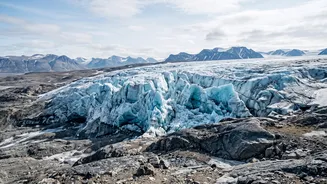
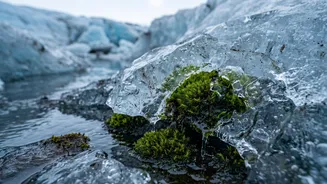
These plant remains are more than just a curiosity; they are extraordinarily precise historical records. As glaciers advance, they entomb the vegetation in their path, effectively flash-freezing it. Scientists can then use a technique called radiocarbon dating on this preserved moss to determine its 'kill date'—the exact moment the ice sheet advanced and cut the plant off from sunlight. As glaciers melt and retreat due to modern warming, they expose these ancient, blackened mosses along their edges. By collecting and dating these samples, researchers can create a detailed map of when and where ice sheets grew in the past.
A New Timeline for Ice Sheets
This technique has yielded stunning results from both poles. In the Antarctic Peninsula, research on re-exposed mosses has revealed at least three distinct phases of glacier advance over the last 1,500 years. On Canada's Baffin Island, warming has unveiled landscapes that have been continuously covered in ice for 40,000 years, since the Stone Age. Some of the most surprising findings come from Greenland, where the discovery of plant fossils, including moss, twigs, and even insect fragments, under miles of ice near the island's center suggests the ice sheet melted completely one or more times in the last million years. This overturns the long-held belief that Greenland's ice was a permanent, impregnable fortress over the last few million years.
From Frozen to Flourishing
Incredibly, some of this ancient moss isn't just a fossil record—it's still viable. In separate studies, mosses buried for 400 years under a Canadian glacier and over 1,500 years in Antarctic permafrost have been successfully revived in labs. When placed in a suitable growth environment, these ancient plants, which appeared black and dead, began to sprout new green shoots. This remarkable resilience shows that as glaciers retreat, they can leave behind a landscape that is ready to spring back to life, with organisms in place that are essentially 'ready to go' as soon as conditions allow.
What This Means for Our Future
This research is not just about understanding the past. The evidence from these tiny mosses provides a stark warning about the future. The fact that the Greenland ice sheet melted during past periods of natural warming—with lower atmospheric carbon dioxide levels than today—shows its profound sensitivity to temperature changes. If the entire Greenland ice sheet were to melt, it would raise global sea levels by about 20 feet, which would be catastrophic for coastal cities worldwide. By pinpointing when and how quickly ice sheets responded to past climate shifts, scientists can refine their models and better predict how our polar regions will react to human-caused warming, making the story of this ancient moss a critical chapter in our own.