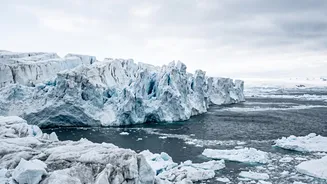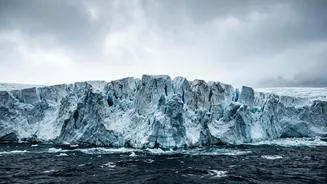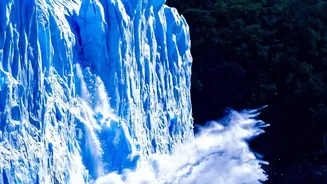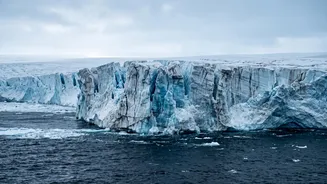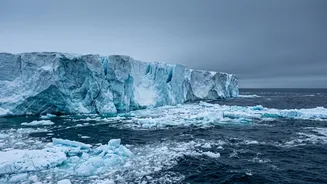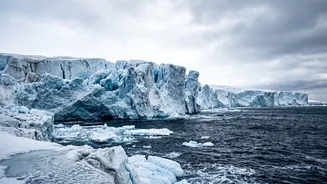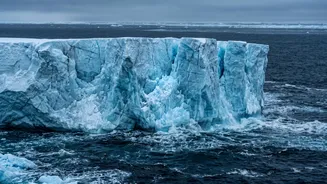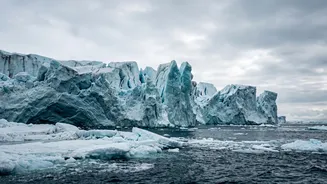





It’s nicknamed the 'Doomsday Glacier' for a reason. Antarctica’s Thwaites Glacier holds enough ice to trigger catastrophic sea-level rise. Now, new research is forcing a major rethink of just how quickly this frozen giant could change our world.
The Florida-Sized Problem
Thwaites
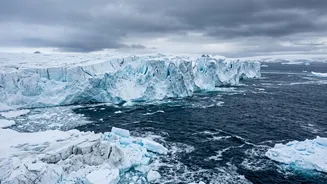
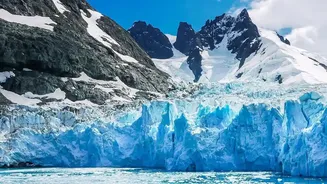
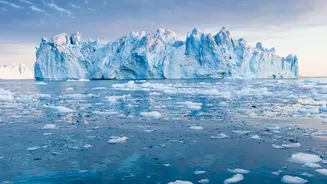
Glacier is one of the widest and fastest-changing glaciers on Earth, spanning an area roughly the size of Gujarat or the US state of Florida. Located in West Antarctica, it acts as a natural dam, holding back a vast quantity of ice in the West Antarctic Ice Sheet. If Thwaites were to collapse entirely on its own, it would raise global sea levels by more than two feet. More alarmingly, its failure would destabilise the entire ice sheet behind it, potentially leading to an eventual sea-level rise of around 10 feet. This makes understanding its behaviour a critical priority for scientists and coastal communities worldwide, including those along India's extensive coastline.
A New Look Beneath the Ice
For years, scientists have modelled the glacier's retreat. However, recent findings published in late 2026 have revealed a significant blind spot in previous projections. A study by researchers from the University of California, Irvine, and NASA’s Jet Propulsion Laboratory used a new computer model that accounts for a crucial, previously underestimated process. They found that warm ocean water is not just nibbling at the edge of the glacier but is penetrating several kilometres under the ice. This creates a 'grounding zone'—a wide area of vigorous melting where the ice was thought to be firmly attached to the bedrock.
Doubling the Projections
The implications of this discovery are stark. By incorporating this new understanding of underwater melting, the model was able to accurately reproduce the glacier's observed retreat over the last few decades—something older models struggled to do. When run forward, the new model projects that Thwaites could contribute up to 30 millimeters (1.2 inches) to global sea-level rise by 2100. This is double the amount predicted by earlier estimates, even without any additional global warming beyond today's levels. While 1.2 inches might not sound like much, it significantly increases the risk and frequency of coastal flooding globally when added to overall sea-level rise.
Risk of an Unstable Future
The aggressive melting underneath the glacier is also weakening its stability. Thwaites is currently held in place, in part, by an underwater mountain ridge known as the Mouginot Ridge. This ridge acts as a pinning point, slowing the glacier's slide into the sea. However, the new simulations show there is now a 60% chance that the glacier will become unpinned from this ridge by the end of the century. Such an event would likely cause the glacier's retreat to accelerate even further as it slips back onto a seafloor that slopes downwards away from the coast, exposing ever more ice to warm ocean currents.
Why This Changes Everything
This study doesn't suggest that the 'doomsday' collapse is happening tomorrow. Instead, it provides a more accurate, and more worrying, picture of the glacier's mechanics. The headline 'raising questions' about earlier estimates is, in this case, not a sign of a reduced threat. On the contrary, the new data confirms that previous models were not aggressive enough. The findings underscore the urgency of understanding these complex systems. The science is not settled in the sense that our knowledge is constantly being refined, but the direction of travel is clear: the threat posed by Thwaites is more dynamic and potentially more immediate than we previously understood.