



The Science of Melting Giants
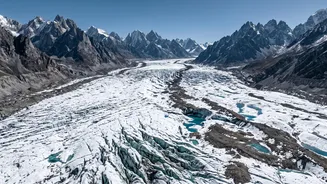
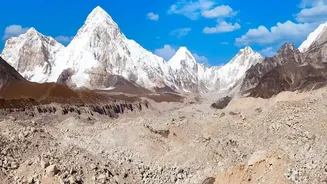
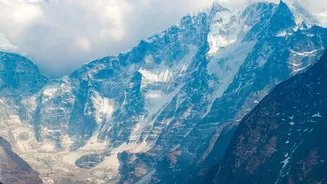
The Hindu Kush Himalayan region is warming at a rate nearly double the global average. This accelerated warming is causing its vast stores of ice to disappear. According to the International Centre for Integrated Mountain Development (ICIMOD), glaciers
across Himalayas have been losing ice at a dramatically faster pace since the year 2000, with the rate of loss doubling in that time. This isn't just a slow melt; it is a fundamental destabilisation of the mountain environment. As glaciers retreat, they leave behind vast quantities of water and unstable debris, setting the stage for sudden, violent events.
The Threat of GLOFs
One of the most significant dangers is the formation of massive glacial lakes. As glaciers melt, water pools behind natural dams made of moraine—loose rock and soil left by the retreating ice. These moraine dams are notoriously unstable. A heavy rainfall event, an avalanche, or even the pressure of the growing lake itself can cause them to burst. The result is a Glacial Lake Outburst Flood (GLOF), a sudden and terrifying event that sends a wall of water, mud, and boulders roaring down mountain valleys. Nepal has experienced 24 GLOF events in the past, and a UN report has identified 21 of the country's over 2,000 glacial lakes as potentially dangerous.
A Cascade of Hazards
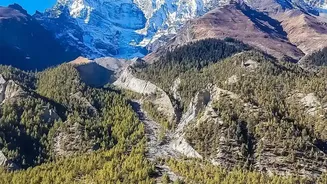
The risk extends beyond GLOFs. The warming climate is also thawing permafrost—the frozen ground that has acted like a cement, holding steep mountain slopes together for millennia. As this 'cryospheric glue' weakens, entire mountainsides become more vulnerable to collapse. A recent catastrophic flood in Nepal in August 2026 was not a GLOF, but a massive rock and ice avalanche that temporarily dammed a river before the water burst through. This cascading disaster, where a landslide triggers a flood, demonstrates how interconnected these mountain hazards are. Scientists have noted this event is a stark reminder of how a changing climate makes the entire Himalayan system more fragile.
Evidence on the Ground
The evidence of this growing instability is clear and disturbing. A devastating flood on August 26, 2026, which originated from a glacier collapse in Nepal's Langtang region, killed hundreds and left thousands missing. The collapse was so powerful it registered as a magnitude 5.2 seismic event. This was not an isolated incident. In July 2025, the same river system experienced a flood caused by the rapid drainage of a glacial lake. Scientific bodies confirm that glaciers in the Hindu Kush Himalaya lost about 12% of their area between 1990 and 2020. This rapid melting directly correlates with the increased frequency of these destructive events.
A Race Against Time
In response, Nepal is taking action, but the scale of the challenge is immense. Projects are underway to lower the water levels in some of the most dangerous glacial lakes, including Thulagi and Lower Barun. The Green Climate Fund and UNDP are supporting a project to deploy early warning systems and protect communities in high-risk river basins. However, experts warn that these efforts, while crucial, may not be enough. The recent disasters highlight the urgent need for more comprehensive research, better cross-border data sharing between countries like Nepal, India, and China, and robust early warning systems that can reach vulnerable downstream communities in time. The risk is not confined to one nation; it is a shared regional vulnerability requiring a united response.