





More Than Just a Meal
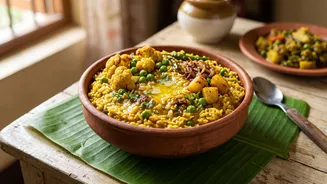
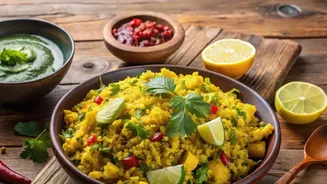
Bhoger Khichuri is not just another dish; it is a sacred offering, or 'bhog', prepared during religious festivals like Durga Puja, Saraswati Puja, and Lokkhi Pujo. This one-pot meal of rice and lentils is first offered to the deities before being distributed
as 'prasad' to devotees. It is a 'niramish' or pure vegetarian preparation, meaning it is made without any onions or garlic, which are considered 'tamasic' or 'rajasic' and thus unsuitable for spiritual offerings. This absence of pungent alliums makes the other ingredients, especially the dal, shine.
The Magic of Dry Roasting
The defining characteristic of Bhoger Khichuri, and the answer to our central question, is the process of dry roasting the yellow moong dal (often a fragrant, small-grained variety called Sona Moong) before cooking. This step, called 'bhaja' in Bengali, is what elevates the dish from a simple khichdi to the revered 'bhog'. The dal is gently toasted in a dry pan until it turns a light golden-brown and releases a deeply nutty, irresistible aroma that fills the kitchen and becomes the signature scent of the final dish.
A Symphony of Aroma and Flavour
Roasting the dal does something magical to its flavour profile. It moves from a raw, earthy taste to a complex, nutty, and almost smoky character. When this roasted dal is combined with aromatic Gobindobhog rice, another key ingredient, the fragrance is amplified. The flavour is further built with 'ghee' (clarified butter), ginger, and a blend of whole spices like bay leaves, cinnamon, cardamom, and cloves. The resulting khichuri is not just savoury but has a subtle sweetness, making it profoundly comforting and memorable.
The Perfect Texture
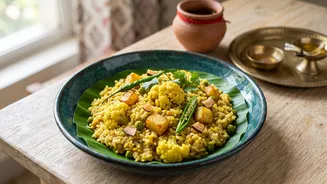
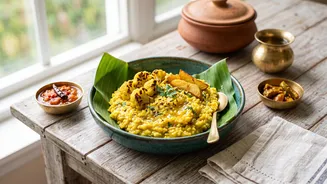
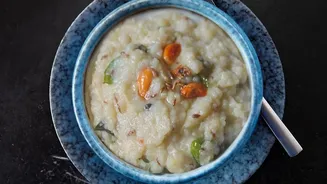
Beyond aroma, roasting fundamentally changes the dal's texture. Raw moong dal breaks down very quickly in water, turning into a soft, homogenous mush. Dry roasting helps the dal grains to hold their shape better during the slow cooking process. The goal of Bhoger Khichuri is not a paste-like consistency, but a thick, porridge-like texture where the rice and dal are soft and melded, yet still discernible. The roasted dal becomes tender without disintegrating, contributing to a satisfying mouthfeel that is creamy yet has substance.
A Symbol of Community and Devotion
Ultimately, Bhoger Khichuri is a dish that transcends its ingredients. It is a symbol of community, often cooked in large quantities in 'pandals' (temporary structures for worship) and shared by everyone, breaking down social barriers. The care taken in its preparation, from roasting the dal to the final tempering with ghee and spices, is an act of devotion. The exclusion of onion and garlic, and the focus on pure, sattvic ingredients, is a way of creating a meal worthy of the divine. The roasted moong dal is central because it is not merely a technical step; it is the first act of love and reverence in creating a dish that is meant to connect the mortal to the divine.